“It shifts hard” is the least useful sentence a customer can hand you, because on a 6L90 it covers a free fix and a teardown with equal ease. The same complaint comes out of a truck in fail-safe, a truck with a kinked cooler hose, a truck that has never been driven long enough to learn its own adapts, and a truck with a pressure regulator bore worn oval. All four feel like a slam in the driver’s seat.
Most harsh-shift 6L90s are not harsh from a broken part. They are harsh because line pressure is higher than the calibration intends, and there are only a handful of reasons that happens. Work them in cost order and you will fix a large share of these without pulling the pan.


Sort the complaint before you touch a wrench
Three questions turn a vague harsh-shift ticket into a short list. Ask them before the truck goes on the rack.
- Which shift, and is it every shift or one shift? Harsh on every engagement including Park-to-Drive and Park-to-Reverse is a line pressure problem or fail-safe. Harsh on one specific upshift is a clutch control problem on that clutch. Harsh only as the truck rolls to a stop is usually the downshift into first, not an upshift at all.
- Cold, hot, or both? Cold-only complaints frequently turn out to be normal behavior or an adapt that has not settled. Hot-only complaints point at heat, fluid and clearance.
- Light throttle or under load? Line pressure is supposed to rise with load. If shift feel does not change between a gentle takeoff and a loaded one, Sonnax lists that exact symptom under clutch boost valve wear as “shift quality is not load sensitive.”
Then pull codes from every module, not just the TCM, and datalog the complaint on the road. Fluid temperature, gear commanded, gear ratio, line pressure command and input and output speed all belong on that screen at once.
Cause 1: fail-safe, which makes maximum line pressure on purpose
Rule this out first, because it takes thirty seconds. Line pressure on this unit is set by a pressure regulator valve in the pump cover, and per Gears Magazine the position of that valve is controlled by a pressure control solenoid inside the TEHCM. The solenoid works by subtraction: the more current the TCM commands, the more the regulator bleeds off and the lower line pressure goes.
So when the TCM drops into fail-safe after an electrical fault, it quits commanding that solenoid. The regulator goes to its mechanical maximum and every apply gets the highest pressure the pump can make. The driver reports a bang into gear and a converter that never locks. Nothing is worn. The unit is protecting itself.
Three tells that you are looking at fail-safe and not wear:
- Engagements are harsh in both Reverse and Drive, not just one.
- Gear Commanded is stuck at a single value on the scan tool while road speed climbs.
- TCC Slip RPM never goes to zero, because the converter clutch is disabled in fail-safe.
Fix the code that put it there. Do not start changing hydraulic parts to chase a symptom the TCM is creating deliberately.
Cause 2: cold fluid, unlearned adapts, and the wrong ATF
GM is unusually blunt about this one. Preliminary bulletin PIP5429, covering 6L45, 6L50, 6L80 and 6L90 units in Silverados and Sierras from 2007 through 2017 among others, states that a 2-3 upshift slip or flare in two specific conditions "is a NORMAL characteristic of the transmission, it will not cause durability concerns and no repair attempts should be made." Both conditions produce a shift the customer will describe as harsh or wrong:
- First 2-3 upshift after sitting engine-off for several hours. GM attributes this to air trapped in the 3-5-R clutch assembly, purged on that first shift. A garage shift into Reverse before Drive purges it and prevents the flare entirely, which is a useful trick: if reversing out of the bay makes the complaint disappear, you have your answer.
- ATF at or below 85°F (30°C). GM instructs you to get fluid to at least 104°F (40°C), then make several shifts at the most sensitive throttle position so the adapts can tailor that shift. GM also notes a revised TCM calibration on TIS2WEB for 2007 vehicles with the 6L90, RPO MYD.
Two related items belong here. Adapts: the TCM trims pressure and fill volume per clutch based on how long each shift actually takes, measured off the input and output speed sensors. Clear them with a calibration update, a TEHCM swap or a valve body replacement and the unit shifts like a raw build until it relearns, which on a short-trip truck takes a while. Fluid: the 6L90 takes DEXRON-VI, which is what GM lists for the 6-speed in the Silverado 2500HD/3500HD owner manual. It is not interchangeable with DEXRON-III, and it is not the low-viscosity fluid the 8- and 10-speeds use. Wrong fluid changes shift feel directly and sends people hunting electrical faults that do not exist.
Cause 3: pressure regulator and boost valve bore wear
With fail-safe, temperature and fluid ruled out, the real repairs start here. The pressure regulator valve oscillates constantly in an aluminum bore, and Sonnax is direct about the result: "Continuous oscillation of pressure regulator valve results in excess bore wear, causing erratic line pressure and/or restricting cooler/lube flow."
Which end of the bore wears decides which complaint you get:
| Wear location | What it does hydraulically | What the driver feels |
|---|---|---|
| Balance spool end of the PR bore | Allows critical fluid loss, so the valve cannot balance and line pressure climbs. Cooler and converter flow drops at the same time. | Harsh shifts, plus overheating |
| Outboard spool of the PR bore | Robs converter feed pressure and lowers line pressure | Soft shifts and burnt clutches |
| Boost sleeve | Loses the pressure rise the boost circuit is supposed to add in Reverse | Reverse engagement problems |
| Clutch boost valve bores | Feedback pressure to the clutch regulator valves becomes unstable | Harsh shifts, slips, flares, delayed engagement, burnt clutches |
That first row is the harsh-shift line. If the balance spool end is worn, the unit is running high line pressure all the time, and you will chase it forever with solenoids and shift kits. The clutch boost valves are the second half of the story: Sonnax describes them as providing "feedback pressure to their respective clutch regulator valves, balancing the regulators to assist with apply and release of the associated clutch," and notes that "excess wear in boost valve bores can result in harsh shifts, slipping, burnt clutches, flares, codes and delayed engagement." Their oversized clutch boost valve 104740-01 lists "shift quality is not load sensitive" at the top of its complaint list, which is exactly the customer who says the truck bangs the same whether it is empty or towing.
Two repair paths. Pressure regulator valve kit 104520-15K is a drop-in with lengthened critical spools that operate in the non-worn portion of the bore, shipped with a new outer spring to replace the weakened original that adds a modest 5 psi across the pressure curve. No pump drilling. If the bore is worn past what a drop-in will seal, oversized kit 104520-16K reconditions it, but that means pulling the pump and reaming with the proper fixture. Worth knowing the history: earlier Sonnax 6L80-series PR valves needed a 45-degree hole drilled through the adjacent channel to supply balance oil to the valve in its regulating position, and Sonnax states that installing without that hole gives "excessively high line pressure." If someone rebuilt this unit before you and skipped that step, you have a manufactured harsh shift sitting in the pump cover.
Cause 4: actuator feed limit bore wear starving every solenoid
The actuator feed limit valve regulates line pressure down to the constant feed the control solenoids meter from, so every clutch pressure control solenoid in the TEHCM sits downstream of it. Sonnax puts it plainly: "Actuator feed limit bore wear causes erratic supply pressure to control solenoids." The complaint list for their AFL valve kit 104740-47K runs solenoid performance codes, clutch failure, wrong gear starts, harsh shifts and soft shifts, all from one bore.
A perfectly good solenoid fed unstable pressure delivers unstable clutch pressure. The TCM commands the same current it always has, gets a different result, the adapt chases it, and shift quality wanders. That is also why a solenoid code here is not proof of a bad solenoid. The kit is a drop-in sleeve and valve giving a new unworn bore while the sleeve seals off existing moderate wear.
Cause 5: heat, cooler lines and the thermal bypass valve
GM bulletin 22-NA-182 lists harsh shifting as the first item in its condition list, covering 6L80, 6L90, 8L90, 10L80, 10L90 and 10L1000 equipped vehicles "before or after the transmission has been overhauled." The cause GM identifies is not internal. It is a twisted cooler line on low-mileage vehicles, which GM notes may also set DTC P27EC in the TCM on ETRS transmissions.
The correction is as simple as it sounds: inspect the cooler lines, removing under-body panels if you cannot see them clearly, disconnect the twisted line at the auxiliary cooler and untwist it, then reconnect and check fluid level. If the line stays misshaped, replace it. That is a bulletin-documented harsh shift fix that costs a hose.
If the lines are straight, the thermal bypass valve is next in the same bulletin. GM specifies that on the 6-speed units, 6L80 and 6L90, the TBV opens at 158°F (70°C) and is external to the transmission. For reference in the same document, the 8L90 valve opens at 194°F (90°C) and the 10-speed units at 143°F (61°C), with the 10-speed TBV inside the valve body on everything except the 3.0L LM2 diesel. A TBV stuck so the fluid never reaches the cooler cooks the unit, and a TBV stuck the other way keeps it cold enough that the adapts in Cause 2 never settle.
Gears Magazine, published by ATRA, adds a warning about the cooler itself after any prior failure: aluminum debris embedded in a cooler acts as insulation, low-pressure auxiliary coolers cannot be safely flushed, and if the unit will not reach operating temperature the bypass valve should be replaced with the updated thermostatic version.
Cause 6: the pump, when the harshness came with a converter failure
If this truck had a torque converter come apart, the pump is a suspect for the shift quality that followed. Gears Magazine notes that metal particulate from a failing converter migrates back into the pump and damages the pump cover and bell housing, degrading efficiency and producing erratic pressure. Numbers to measure rather than eyeball, from that same coverage: rotor and slide end clearance 0.0008″ to 0.002″ (0.02032 to 0.0508 mm) checked with plastigage in multiple positions with the cover bolts torqued to spec, input endplay typically 0.004″ to 0.006″, and slide return spring pocket clearance 0.020″ minimum. Machined stators and bell housings have had material removed and need shimming back.
On the vehicle, put a mainline gauge on the passenger-side pressure port and compare actual pressure against the EPC command through the range rather than reading idle and walking away. Gears is direct that most failures on this family are pressure-related, that low pressure rising with engine speed points to pump output, and that a shaky needle at idle or hot delayed engagement points to pump clearance.
Vacuum test the valve body instead of guessing
Bore wear does not show up under a magnifying glass. It shows up on a vacuum gauge. The Sonnax method is to work with the valve body dry, seal the circuit, and pull air past the spool: tight valve-to-bore clearance restricts airflow and holds vacuum, while a worn bore lets air past. Their published reference comparison is a known-good bore returning 18 in-Hg against a known-bad bore in the same location returning 10 in-Hg.
Test the pressure regulator bore, the actuator feed limit bore and each clutch boost valve bore. Then you are replacing parts because a gauge told you to, not because a catalog listed your symptom. Vacuum test the TCC regulator valve too if the complaint includes a hard converter apply, since Sonnax ties wear there to harsh TCC apply and codes P0741 and P0742. Note also that the CBR1/4-5-6 clutch regulator valve is a 6L80 and 6L90 only valve, so a 6L45 or 6L50 layout drawing will not match what is in front of you.
The order I actually work one
- Scan all modules. If codes put the unit in fail-safe, stop and fix those first.
- Check fluid level hot and confirm it is DEXRON-VI. Look at the color and smell it.
- Inspect cooler lines for the twist in 22-NA-182. Check that fluid temperature climbs to and holds a normal operating range on a datalog.
- Ask whether adapts were recently cleared, and whether the complaint is cold-only or the documented first-2-3 behavior in PIP5429.
- Mainline gauge on the passenger-side port, actual versus EPC command through the range.
- If pressure is high and unexplained, pull the valve body and vacuum test the PR, AFL and clutch boost bores.
- Repair the bores that failed the test. Only then consider a calibration change, and only if the shift is actually soft or overlapping.
That sequence keeps the cheap fixes in front of the expensive ones.
FAQ
Why does my 6L90 shift harsh only when the truck is cold?
Because the fluid is thick and the TCM has not adapted for those conditions yet. GM bulletin PIP5429 covers 6L45, 6L50, 6L80 and 6L90 units and states that a 2-3 upshift flare can occur when ATF temperature is at or below 85 degrees F (30 degrees C), and that a first 2-3 upshift after the vehicle has sat engine-off for several hours can be caused by air trapped in the 3-5-R clutch. GM calls both normal and says no repair attempts should be made. Drive the truck to at least 104 degrees F (40 degrees C) and see whether the complaint survives.
Can a bad cooler line really cause a harsh shift on a 6L90?
Yes, and GM documents it. Bulletin 22-NA-182 lists harsh shifting first in its condition list for 6L80, 6L90, 8L90, 10L80, 10L90 and 10L1000 vehicles, and names a twisted cooler line on low-mileage vehicles as the cause. The fix is to disconnect the line at the auxiliary cooler, untwist it, reconnect and recheck fluid level, replacing the line if it stays misshaped. GM also notes a twisted line can set DTC P27EC in the TCM on ETRS units.
My 6L90 slams into gear and will not lock the converter. What is that?
That is almost certainly fail-safe, not a worn valve body. Line pressure here is set by a pressure regulator valve in the pump cover whose position is controlled by a pressure control solenoid in the TEHCM. When the TCM drops into fail-safe it stops commanding that solenoid, the regulator goes to maximum, and every engagement gets full line pressure. Scan all modules for codes before condemning anything hydraulic.
Where do I tap line pressure on a 6L90, and what am I looking for?
Put a mainline gauge on the passenger-side pressure port and compare actual pressure against the EPC command through the range, not just at idle. Gears Magazine notes that most failures on this unit family are pressure-related, that low pressure which rises with engine speed points at pump output, and that a shaky needle at idle or delayed engagement when hot points at pump clearance. The commanded-versus-actual gap is the number that matters.
Will a shift kit fix a harsh shifting 6L90?
Only if the harshness comes from a soft or overlapping shift, which is the opposite of most harsh 6L90 complaints. If the unit is harsh because line pressure is already too high from pressure regulator balance spool wear, from fail-safe, or from a stuck bypass valve cooking the fluid, adding pressure makes it worse. Find out why pressure is high first.
Need parts for this job?
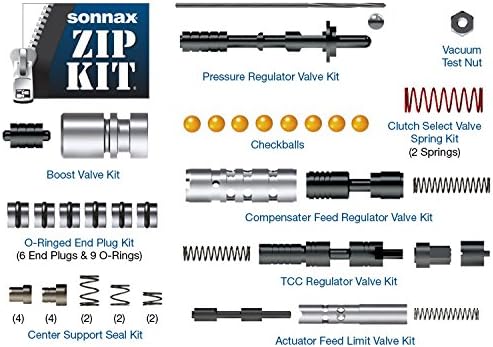
Most of what fixes a harsh shifting 6L90 lives in the valve body and the pump cover: pressure regulator valve kits, valve body Zip Kits that address the actuator feed limit and clutch boost bores, TCC regulator kits, complete valve bodies, pumps and the reamer tooling if you are going oversized.
Browse all 6L90 transmission parts →
6L90 Oil Pump Rotor Kit
If the harsh shift followed a converter failure, or the mainline gauge needle is shaky at idle, the pump rotor set is where the pressure problem usually starts. Sold through our sister store CoreTransmissionParts.
View the 6L90 pump rotor kit →Sources
- General Motors — Service Bulletin 22-NA-182, "Information on 6L80 6L90 8L90 10L80 10L90 10L000 Equipped Vehicles With A Harsh Shift, Shudder, Surge, Stall, Neutral/Flare, Transmission Overheating and/or High Transmission Fluid Temperature," December 2022 (replaces PIP5792E). Backs harsh shifting being the first listed condition before or after overhaul, the twisted cooler line on low-mileage vehicles as the stated cause, DTC P27EC setting in the TCM on ETRS transmissions, the untwist-or-replace correction and the instruction to remove under-body panels to inspect, and the thermal bypass valve opening temperatures of 158°F (70°C) external on the 6L80/6L90, 194°F (90°C) on the 8L90, and 143°F (61°C) inside the valve body on the 10-speeds except the LM2 diesel. nhtsa.gov (PDF)
- General Motors — Preliminary Information Bulletin PIP5429, "2-3 Upshift Slip or Flare," October 2016 (6L45, 6L50, 6L80, 6L90 applications including 2007-2017 Silverado and Sierra). Backs GM calling the condition a normal characteristic that needs no repair attempt, air trapped in the 3-5-R clutch assembly causing the first 2-3 upshift flare after the vehicle sits engine-off for several hours, the garage shift into Reverse purging that air, the 85°F (30°C) ATF threshold and the 104°F (40°C) target for letting adapts tailor the shift, and the revised TCM calibration released on TIS2WEB for 2007 vehicles with the 6L90 RPO MYD. nhtsa.gov (PDF)
- Sonnax — Oversized Pressure Regulator & Boost Valve Kit 104520-16K, GM 6L45/6L50/6L80/6L90. Backs the quoted cause that "continuous oscillation of pressure regulator valve results in excess bore wear, causing erratic line pressure and/or restricting cooler/lube flow," that deterioration at the balance spool end allows critical fluid loss resulting in high line pressure, harsh shifts and overheating from reduced cooler/converter flow, that wear at the outboard spool robs converter feed pressure and lowers line pressure resulting in soft shifts and burnt clutches, that wear at the boost sleeve causes Reverse issues, and the pump-removal and reaming-fixture requirement for the oversized repair. sonnax.com
- Sonnax — Pressure Regulator Valve Kit 104520-15K, GM 6L45/6L50/6L80/6L90. Backs the drop-in repair with lengthened critical spools that operate in the non-worn portion of the bore, the included replacement outer spring for weakened originals, the modest 5 psi line pressure increase across the curve, the "no pump drilling required" note, and the complaint list that includes erratic, high and low line pressure, harsh shifts, soft shifts, clutch slippage, low or no cooler flow and overheated transmission. sonnax.com
- Sonnax — Oversized Clutch Boost Valve 104740-01, GM 6L45/6L50/6L80/6L90; and Actuator Feed Limit Valve Kit 104740-47K. Backs clutch boost valves providing "feedback pressure to their respective clutch regulator valves, balancing the regulators to assist with apply and release of the associated clutch," the statement that "excess wear in boost valve bores can result in harsh shifts, slipping, burnt clutches, flares, codes and delayed engagement," the "shift quality is not load sensitive" complaint, and for the AFL kit the statement that "actuator feed limit bore wear causes erratic supply pressure to control solenoids" along with its solenoid performance code, wrong gear start, harsh and soft shift complaints and drop-in sleeve repair. sonnax.com
- Sonnax — "Vacuum Testing for Leakage," and "GM 6L45, 6L50, 6L80, 6L90 Valve Body Layout." Backs the dry-valve-body vacuum test method in which tight valve-to-bore clearance restricts airflow and holds vacuum, the reference comparison of a known-good bore at 18 in-Hg against a known-bad bore in the same location at 10 in-Hg, the TCC regulator valve kit 104740-46K being tied to harsh TCC apply and codes P0741 and P0742, and the CBR1/4-5-6 clutch regulator valve being a 6L80/6L90-only valve. sonnax.com
- Gears Magazine (ATRA) — "6L80/6L90: Issues That Could Drive You Crazy" and "Rise and Fall: 6L80/6L90 Pressure Issues." Backs most failures on this unit family being pressure-related, the pressure regulator valve living in the pump cover with its position controlled by a pressure control solenoid in the TEHCM, the mainline gauge on the passenger-side pressure port compared against EPC command, low pressure that rises with engine speed pointing at pump output and a shaky needle at idle or hot delayed engagement pointing at pump clearance, converter metal migrating back into the pump and damaging the pump cover and bell housing, the 0.0008″-0.002″ rotor/slide end clearance, 0.004″-0.006″ input endplay and 0.020″ minimum slide spring pocket clearance measured with plastigage, and aluminum debris in a cooler acting as insulation with the updated thermostatic bypass valve as the fix when the unit will not reach operating temperature. gearsmagazine.com
- Chevrolet — 2022 Silverado 2500HD/3500HD Owner Manual, "Recommended Fluids and Lubricants." Backs the DEXRON-VI Automatic Transmission Fluid specification for the 6-speed transmission. chevrolet.com (PDF)