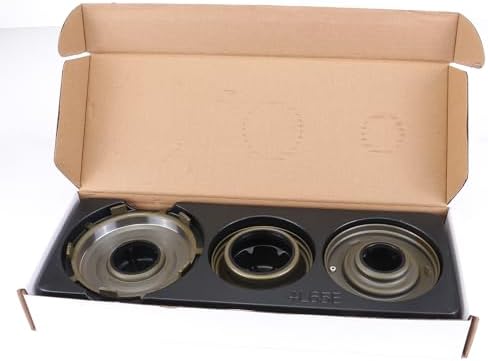
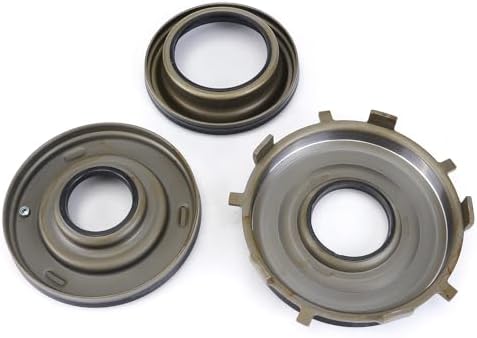
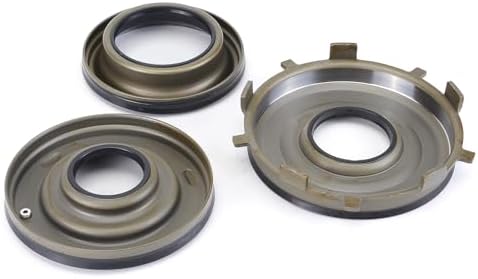
A Silverado or Tahoe that slips into third, a Camaro that flares on the 2-3 under throttle, or an S10 that came apart with burned 3-4 frictions all share a common question: why did the pack burn? Very often part of the answer is in the input housing, where three pistons share one drum. This set replaces all three, the 3-4, forward and overrun pistons, with new bonded parts for the 1994-up 4L60E input housing. It also fits the 4L65E and 4L70E.
How to tell the three pistons apart
Laid on the bench, they are easy to sort. The 3-4 piston is the smallest diameter of the three and applies the clutch pack that carries third and fourth gear. The forward piston is large and has drive teeth around its outside edge. The overrun piston is also large and carries a check ball, which lets the apply oil exhaust when the clutch releases. On these pistons the rubber lip is bonded to the steel, so the old step of fitting separate lip seals, and the chance of rolling one, is gone.
Why a worn piston burns new clutches
Clamping force on a clutch pack comes from oil pressure acting on the piston, and a lip that has gone hard or taken a set lets some of that oil escape. Sonnax names leaks in the third-gear oil circuit and low line pressure as the root of most 4L60E 3-4 slipping, which is why a builder who puts new frictions behind an old 3-4 piston often sees the same burn again. The overrun piston matters too. Its check ball has to seal for the overrun clutch to hold in manual ranges and exhaust cleanly when it releases. Our 4L60E overrun clutch guide explains what that clutch does and what it feels like when it fails.
Symptoms that lead back to the input housing
- Engine flare on the 2-3 shift that gets worse as the fluid heats up
- Slipping in third or fourth under load, or when towing
- Black, burned 3-4 frictions with blued steels at teardown
- Delayed or soft engagement into Drive
- No engine braking in manual 1 or 2
Confirm it on the bench
A worn piston is not the only cause of these symptoms. A worn pump, a leaking third accumulator or a stripped sun shell can produce similar complaints, so inspect the whole unit. With the housing apart, look for scored bores, a cracked housing and worn sealing rings. Sonnax describes vacuum testing the input housing circuits and the checkball, which shows a leak you might miss by eye. Before you buy anything else, our 4L60E common problems guide sorts out which symptom points to which part.
Fitment
These are the current-design pistons for the 1994-up 4L60E input housing and also fit 4L65E and 4L70E housings. They can go into a 1982-1993 700R4 or early 4L60 housing only with the updated return spring assembly, GM 24206085, which is not in this set. If your housing is from the changeover years or has been swapped before, compare the old pistons to the new ones before you start. Send us the year and VIN if you are unsure. Find more internal parts on our 4L60E parts page.
Install notes
- Compress the return spring with a clutch spring compressor, remove the snap ring and spring and lift the pistons out.
- Clean each bore and check for scoring that would cut a new lip.
- Lube the lips with assembly gel or clean Dexron VI.
- Ease each piston in square, using a lip tool or a smooth thin wire so the lip does not fold.
- Refit the spring and snap ring, then air check the forward, overrun and 3-4 circuits before the housing goes in.
A 4L60E rebuild tool kit covers the spring compressor work, and if the frictions are burned, a high friction deluxe rebuild kit pairs well with these pistons.