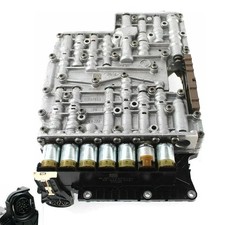
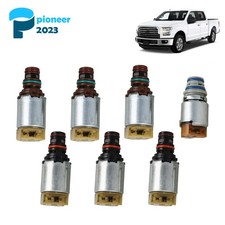
The Ford 6R80 ran in F-150, Expedition, Mustang, Explorer, the international Ranger and Lincoln Navigator from 2009 through 2017, and Ford changed the valve body casting and solenoid pack more than once over that run. This listing is a remanufactured 6R80 valve body built from a core unit matched to your vehicle's casting and connector count, so before it ships we confirm the revision against your year and VIN rather than guessing from the model name alone.
Why the 6R80 valve body wears
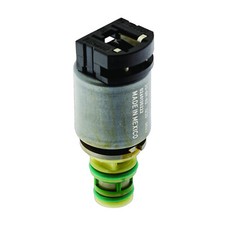
Every shift and every torque converter lockup on this transmission runs through the valve body first. Line pressure from the pump travels through a set of precision bores and spool valves inside the casting, and on this electronically controlled unit the valve body also carries the shift solenoids, the pressure control (EPC) solenoid, and the TCC solenoid the computer commands to time each shift. Repeated heat cycles and fine contamination in the fluid wear those bores and solenoid bleed orifices over tens of thousands of miles, which is why a 6R80 with otherwise clean fluid can still start shifting rough.
Which revision does your 6R80 have
Ford made at least two changes worth knowing about. Shift Solenoid E switched from a 10.5-ohm tan-snout design to an 18-ohm design in November 2010, and Sonnax has documented a separate casting and separator-plate change on 2015-and-later valve bodies. That means a 6R80 built in 2009 and one built in 2016 are not interchangeable parts even though the transmission code is the same. Give us your year, model and VIN when ordering so the casting and solenoid pack we send match what is coming out of your vehicle.
Symptoms this fixes
- Harsh, delayed, or flared shifts anywhere in the gear range
- Random slipping or a missing upshift under light or heavy throttle
- Torque converter clutch shudder or slip, usually noticed at steady highway cruise
- Limp mode triggered by a stored shift-solenoid, EPC, or ratio code
- Erratic shift behavior that seems to track with transmission fluid temperature
Our 6R80 valve body wear guide covers how these symptoms typically progress as the bores and solenoid orifices wear, and our EPC solenoid symptoms guide is worth checking first if pressure-related codes are the main complaint, since a solenoid alone is a cheaper fix than a full valve body.
Fitment
Covers 2009-2017 Ford and Lincoln vehicles built with the 6R80, across both the pre- and post-November-2010 solenoid spec and the 2015-and-later casting update. Because of those running changes, this is not a one-size listing: confirm your build date and VIN before ordering, or browse the year-specific 6R80 valve bodies on the 6R80 parts page if you already know which revision you need.
Install notes
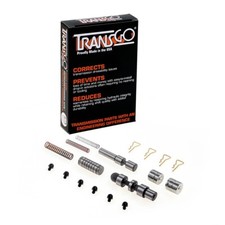
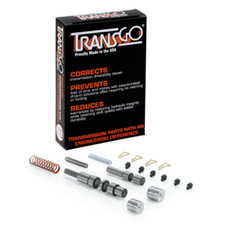
Drop the pan and swap the filter and fluid at the same time so contamination from the old unit does not carry over into the new solenoids; a full 6R80 master rebuild kit is worth pairing with this if the fluid came out dark or burnt. Torque the valve body bolts in Ford's specified sequence, refill with Mercon LV ATF, and run the adaptive shift relearn with a scan tool before calling the job done. If shift quality still feels off after the relearn, a 6R80 shift kit addresses the accumulator and spring side of shift feel that a valve body swap alone does not touch.