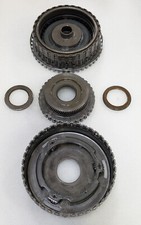
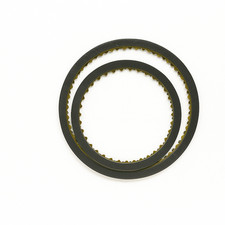
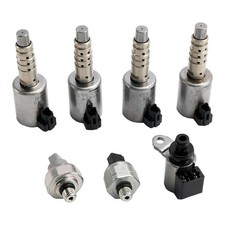
If a 2013-2018 Nissan with the 2.5L engine and the Jatco JF016E CVT takes a long time to move after you select Drive or Reverse, flares RPM when pulling away, or left aluminum and friction debris in the pan, the clutch drums in the forward/reverse section are on the suspect list. This is a remanufactured JF016E clutch drum set for that 2013-2018 range. As pictured it is a stacked set of three pieces, two drums and the hub that nests between them, plus two thrust washers, so the rebuilder replaces the whole forward/reverse drum stack instead of mixing one new piece with worn mates.
What the clutch drums do in a JF016E
The JF016E (Nissan calls it the RE0F10D) is the 2.0-2.5 liter member of the Jatco CVT8 family. Ratio changes happen at the steel push belt and two variable pulleys, but the belt cannot reverse direction on its own. That job falls to a small planetary gear set right behind the torque converter, controlled by just two friction elements: a forward clutch that locks the planetary for Drive and a reverse brake that holds a member of the set for Reverse. The drums carry those clutch packs and the apply piston, and their bushings and sealing ring lands keep oil pressure inside the piston cavity.
Both elements are fed by the select solenoid circuit in the valve body. When a drum leaks at a worn ring land or a cracked piston bore, the solenoid can command full pressure and the pack still will not clamp, so the CVT behaves like it has a bad belt when the belt is fine.
Symptoms of a worn JF016E drum
- Long delay engaging Drive, Reverse or both, usually worse once the fluid is hot
- Slipping or RPM flare on take-off that settles once the car is rolling
- Harsh bang into gear after a long delay as the pack finally grabs
- Aluminum flakes, bronze bushing material or burnt friction lining in the pan and filter
- No movement at all after a rebuild, which often traces to a reused drum with a damaged seal surface
How to confirm it before buying
Slipping in Forward and Reverse is not always a drum problem. Sonnax lists worn primary pulley reducing valve bores in the JF016E valve body as a cause of slips in Forward and Reverse, so read line pressure and check codes first. Our CVT slipping under load guide walks through separating a pressure fault from a mechanical one, and the harsh or delayed engagement walkthrough covers timing the delay into gear. If pressure is good and the delay is in one direction only, the drum, piston seals and plates for that element are the likely cause. Once the unit is apart, look for scored ring lands, a wobbling bushing and blued steel plates.
Fitment
This set is listed for the JF016E in 2013-2018 models. The JF016E sits behind the 2.5L four-cylinder, mainly in the Altima 2.5 and Rogue from those years. It is not the same transmission as the 3.5L JF017E, which uses a chain instead of a belt. Because Jatco revised internal parts through the production run, match the drums against your originals before you install them: outside diameter, spline count, number of plate slots and the hub height. The simplest path is to send us your year, model and VIN before ordering. More CVT parts are on our CVT transmission parts page, and a single-drum option for 2013 units is listed as the JF016E clutch drum 2013.
Install notes
- Inspect each bushing and the sealing ring grooves, then install new sealing rings and piston seals. Do not reuse old rings on a fresh drum.
- Soak new frictions in Nissan NS-3 CVT fluid before assembly, and air-check each piston once the packs are built.
- Set clutch clearance to the factory specification with selective plates; too tight drags, too loose brings the delay back.
- Fit both thrust washers in their original positions and check end play before closing the case.
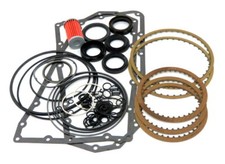
- Replace the soft parts at the same time. The JF016E banner rebuild kit supplies the gaskets, seals, frictions and filter.
- Refill with NS-3 only, then perform the Nissan CVT fluid level check at the specified temperature.
For the bigger picture on what fails in these units and in what order, see our Jatco CVT Nissan problems and fixes guide.