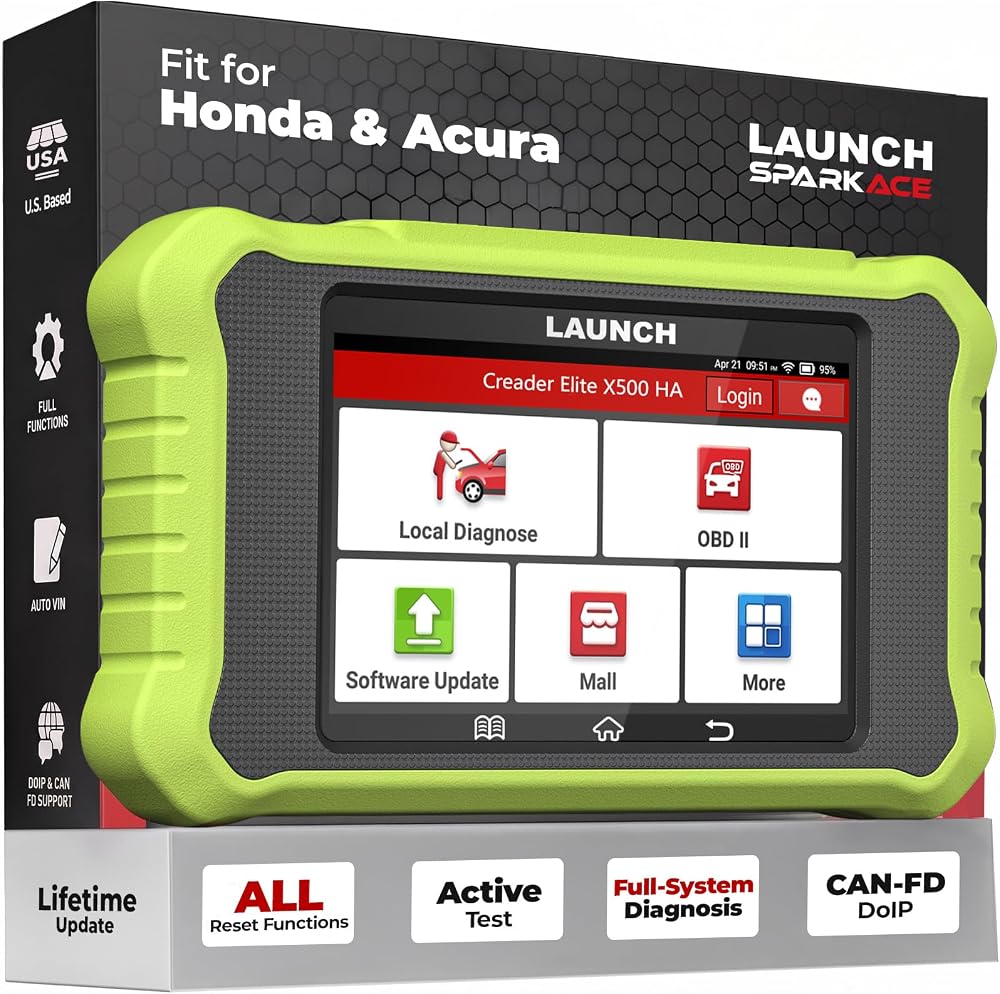
If your Honda Civic, CR-V, Accord or Acura has a CVT that judders, flares, groans on a hot restart or throws the transmission light, a generic code reader usually tells you very little. The LAUNCH Creader Elite X500 is the Honda and Acura edition of LAUNCH's Creader Elite line. It talks to the transmission control module directly, shows the data that separates a fluid problem from a hardware problem, and runs the active tests and resets that otherwise mean a trip to the dealer.
What this scan tool does on a Honda CVT
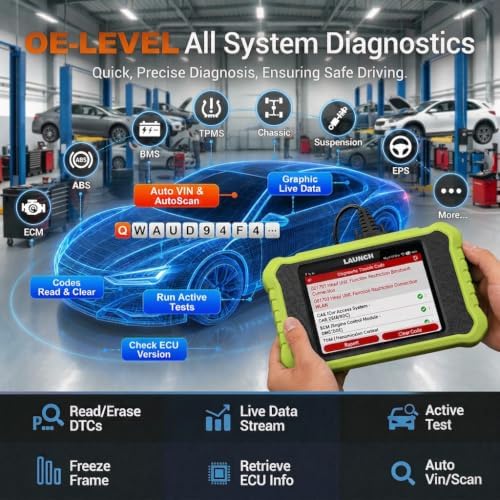
Honda's belt-type CVTs change ratio by moving the drive and driven pulley halves with hydraulic pressure, and the TCM decides that pressure from what its sensors report. When something goes wrong the TCM logs a Honda-specific code, and a basic OBD2 reader often reduces that to a bare P0700 or nothing at all. The X500 reaches more than 160 systems on Honda and Acura vehicles, including the TCM, ECM, ABS and SRS, and shows live data for input and output shaft speed, ATF temperature, pulley pressures and commanded versus actual ratio. When actual ratio lags behind commanded ratio under steady throttle, you are looking at slip. When ratio is steady but the car shudders on light throttle, the converter lock-up and the fluid move up the list.
Bidirectional control lets you command a component and watch the result, which is how you split a bad actuator from a bad circuit. The tool also carries more than 30 special functions, including oil reset, EPB retract, TPMS, steering angle calibration, ABS bleeding, throttle relearn, injector coding and battery registration. The listing covers CVT and automatic resets; which procedures appear depends on the model and year, so check the menu against your VIN.
Symptoms this tool helps you run down
- Transmission or check engine light with no obvious mechanical cause
- Light-throttle shudder or judder between roughly 20 and 60 mph
- Grinding or groaning from the CVT right after a hot restart (2016-2017 Civic 1.5L)
- Engine stalling seconds after shifting into Reverse on a cold start (2015-2016 CR-V and Accord L4 CVT)
- Flare, slipping or a delayed engagement after a fluid service or repair
- Erratic shifting after a weak battery or a jump start
How to confirm the problem before you buy parts
Start with a full-system scan, not just the TCM. Transmission technicians report that a large share of CVT complaints trace to a weak battery or a fault in another module, so clear the battery and ABS codes first. Next, check fluid level the way Honda intends: CVT level is set at a specified temperature read from the transmission's own sensor, which you watch in live data, not with an infrared thermometer. Then road test while logging ratio, shaft speeds and ATF temperature. Our Honda CVT maintenance guide covers the HCF-2 fluid requirement and the known bulletins, and CVT slipping under load explains how to read slip in the data. If the data points at hydraulics, a digital transmission pressure tester confirms it mechanically.
Fitment and coverage
This is the Honda and Acura dedicated version, so its full-system depth applies to those two makes. It keeps generic OBD2 coverage for other brands, which reads emissions codes and basic data but not the deep Honda-style functions. AutoVIN identifies 2006 and newer vehicles in one touch. It runs on 12V passenger cars and light trucks only and does not cover 24V heavy-duty trucks. For other CVT parts and tools, see our CVT parts collection.
Using it well
- Update the software over Wi-Fi before the first job; updates are free for life with no annual subscription and no PC needed.
- Keep a battery maintainer on the car during long sessions so low voltage does not interrupt a relearn.
- Run any relearn after the repair, not before, and road test afterward so the TCM can finish adapting.
- Refill with Honda HCF-2 where the vehicle calls for it, and confirm level at temperature using the tool's ATF temperature reading.
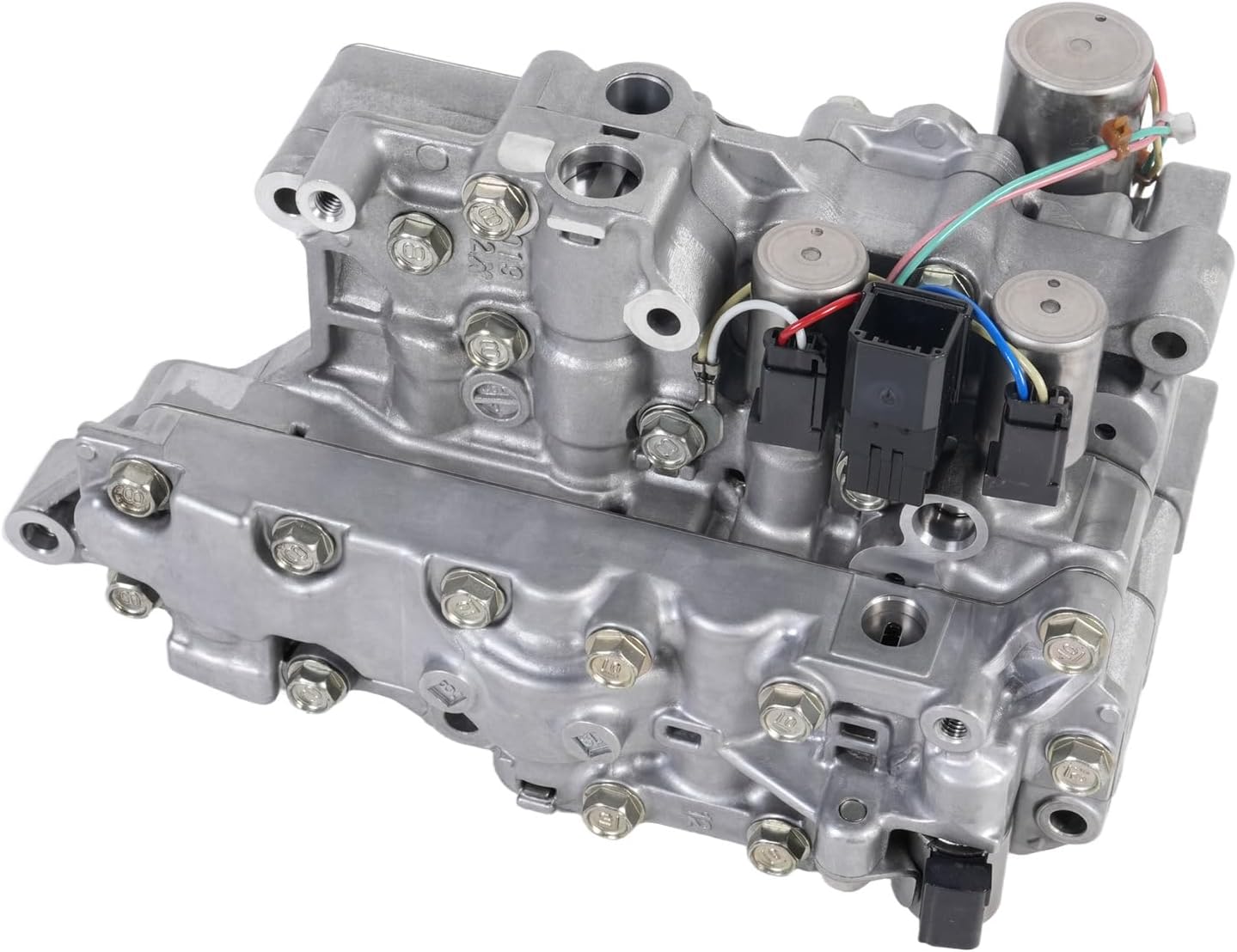
- If the data shows a hydraulic fault, the Honda CVT valve body 27000-5LJ-014 covers Civic 1.5L, CR-V and Accord 1.5L units.
The 4-inch Android 8.1 touchscreen with 2GB RAM and 64GB storage keeps reports on the device, and a health report can be shared or printed so the customer sees the same data you do.