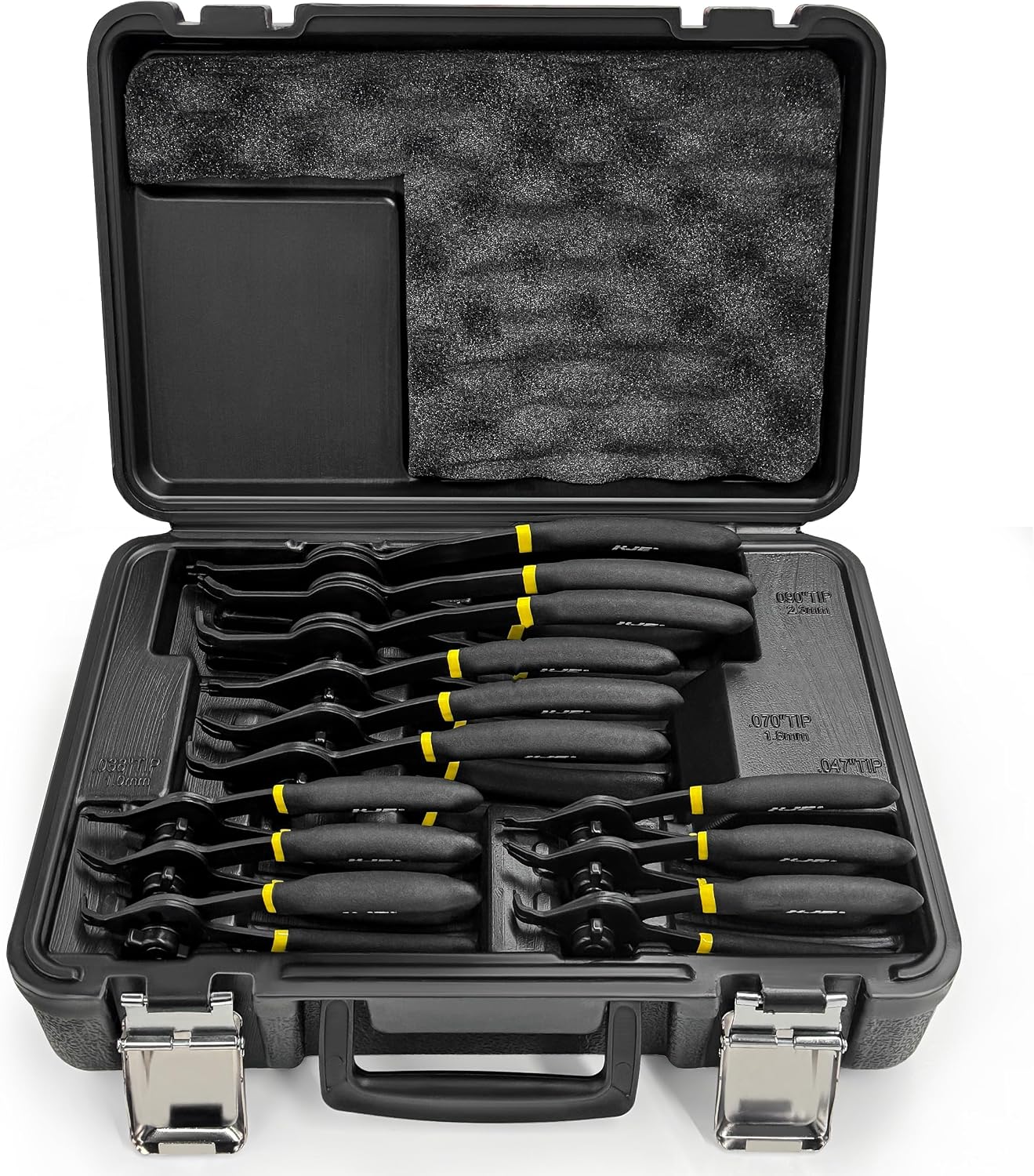
Every automatic transmission rebuild is a string of retaining rings: the ring that holds a clutch pack in its drum, the one that keeps a piston return spring retainer in place, the selective ring that sets clutch clearance, and the small rings on shafts, accumulators and valve body plugs. Most of them sit at the bottom of a drum or behind a shaft where straight pliers cannot reach square. This 12-piece fixed-tip set gives you the length, tip size and jaw angle to get onto each ring cleanly, in internal or external action, without bending the ring or scoring the bore.
What is in the set
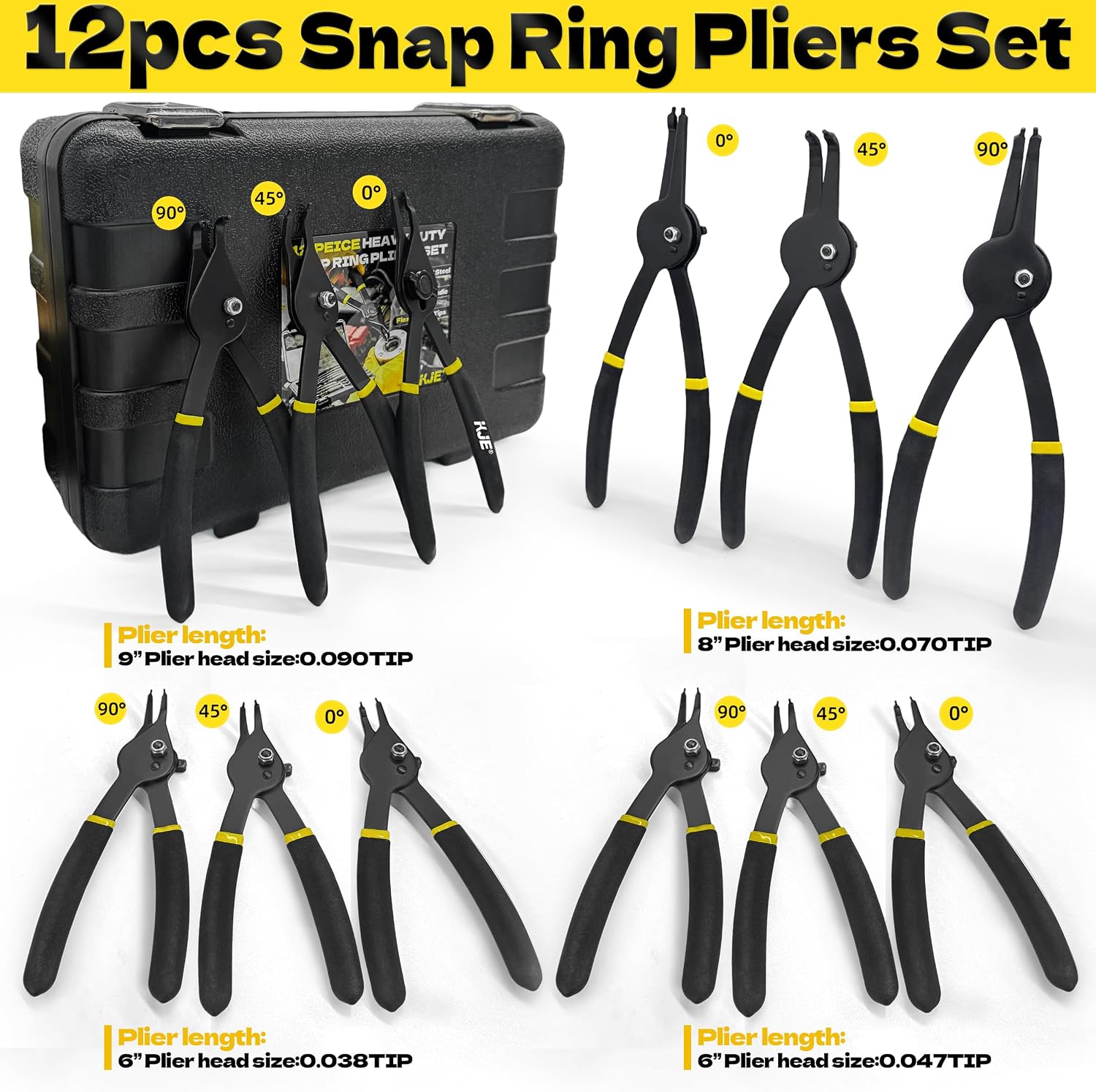
- Twelve pliers in 6, 8 and 9 inch lengths
- Four tip diameters: .038, .047, .070 and .090 in
- Three jaw angles: 0 degrees (straight), 45 degrees and 90 degrees
- Quick-release button on each plier that switches it between internal and external action
- Fixed tips, forged CRV steel, heat treated with a phosphate finish, cushioned non-slip handles, molded storage case
What snap ring pliers do on a transmission bench
Internal rings sit in a groove inside a bore and want to spring outward, so internal-action pliers close the tips when you squeeze to shrink the ring out of its groove. External rings sit on a shaft and want to spring inward, so external-action pliers open the tips to expand the ring over the shaft. Being able to flip one plier between the two modes means a single tool covers both ring types at that size and angle. The angled jaws are the real reason to buy a set like this: a 45 or 90 degree tip lets you come at a ring buried deep in a clutch drum or reaction shell from the side and still seat both tips fully in the lug holes.
Signs you are using the wrong pliers
- Tips that slip out of the lug holes under spring load, or a ring that launches across the shop
- Rings that come out twisted or overspread and no longer sit flat in the groove
- Bright scratch marks in a drum or case bore where a tip skated across it
- Bent or snapped tips, which usually means the tip was too small for the lug hole and carried all the load at its end
How to choose the right tip
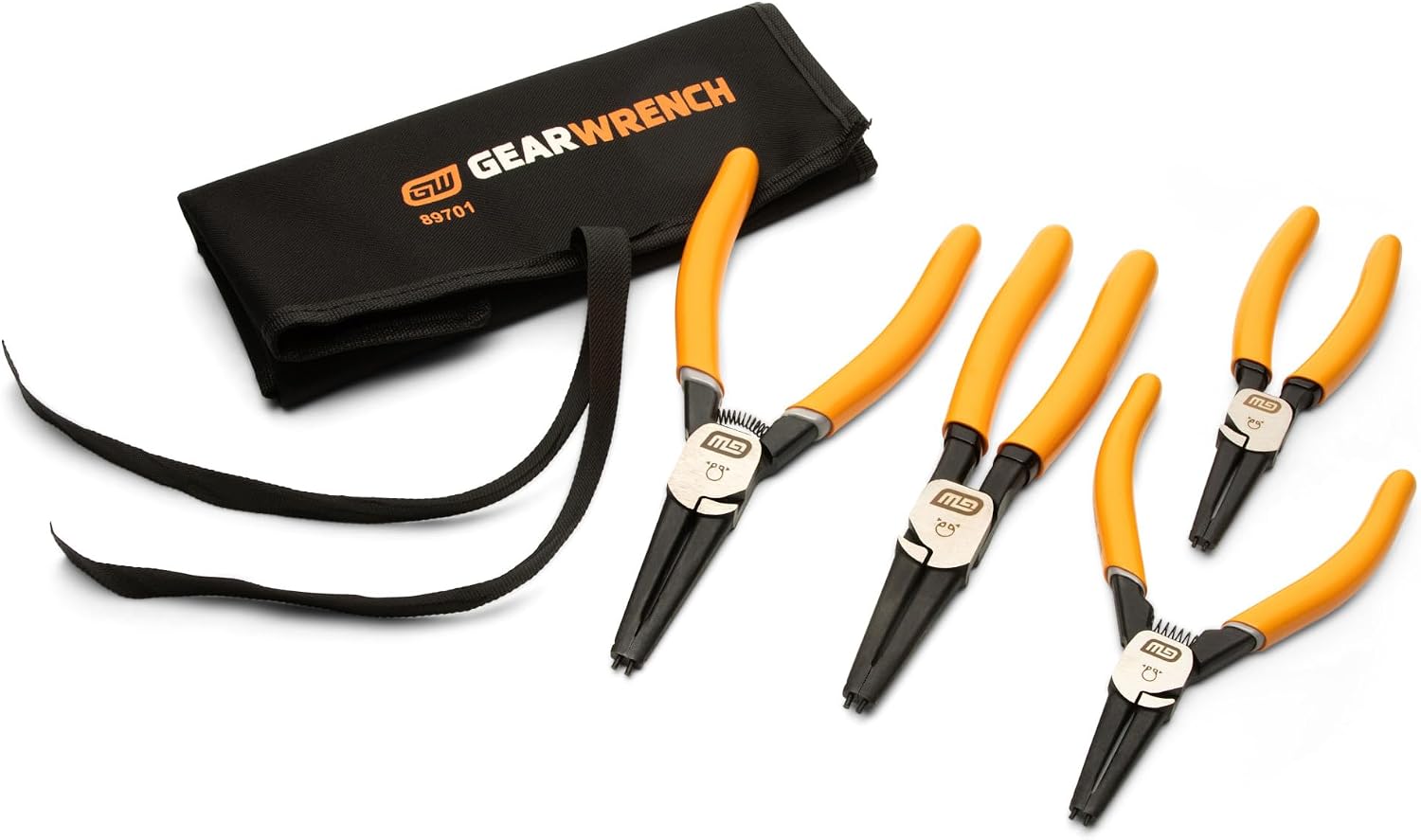
Match the tip to the lug hole, not to the ring diameter. The largest tip that drops fully into the hole without forcing is the right one, because it spreads the load across the eye and is least likely to slip. Small rings with tiny eyes need the .038 or .047 in tips; the large rings that retain clutch packs and return-spring retainers usually call for the .070 or .090 in tips. Use straight jaws when you can see the ring face-on, and switch to 45 or 90 degree jaws as soon as you would otherwise have to tilt the tool. If you also want a compact second set for the roll-around toolbox, the GEARWRENCH 89701 4-piece set covers 7 and 9 inch sizes.
Fitment and compatibility
These pliers are not tied to one transmission. They suit the internal and external retaining rings found in GM, Ford, Chrysler and import automatics, manual gearboxes, transfer cases and axle assemblies, as long as the ring lug hole accepts one of the four tip sizes. If you are unsure, measure the lug hole with a drill bit or pin gauge before you start. You will find the rest of the bench tools we carry in our transmission tools collection.
Using them on a rebuild
- Wear eye protection. A ring that slips under load leaves the tool fast.
- For a piston return spring retainer, compress the springs first with a clutch spring compressor, then remove the ring with the pliers; never fight spring pressure with the pliers alone.
- Squeeze or spread only as far as needed to clear the groove. Overspreading a ring takes its set and it will not hold tension when reinstalled.
- Install each ring with its gap away from any slot or window, and rotate it in the groove to confirm it is fully seated.
- After installing the pressure plate ring on a clutch pack, check clearance with a feeler gauge and change to a thicker or thinner selective ring as the spec requires, then air check the pack.
Our bench rebuild tools guide lists what else belongs on the bench, and the air check procedure shows how to confirm each clutch after the rings are in.