Astro shift complaints come in a few repeat patterns. The van pulls away in 3rd and never shifts. It hangs in 1st and then bangs into gear. It starts in 2nd and never finds overdrive. It flares between 2nd and 3rd on a loaded highway on-ramp. Most can be pinned down with a scan tool, a test light and the 4L60E solenoid table before the van ever goes on a lift.
The short version: Rule out the driver settings first. On vans that have the tow/haul button, GM says tow/haul cuts shift frequency and gives "undesirable performance" when it is left on without a trailer. Then use the solenoid table. A 4L60E with both shift solenoids off is in 3rd, so a van stuck in 3rd in Drive with a working manual 2nd has lost solenoid power. Starting in 2nd with no 4th points at the A solenoid or a worn AFL valve bore. Harsh shifts with no transmission codes call for a look at the commanded pressure control solenoid current and at engine faults before anyone starts replacing parts.


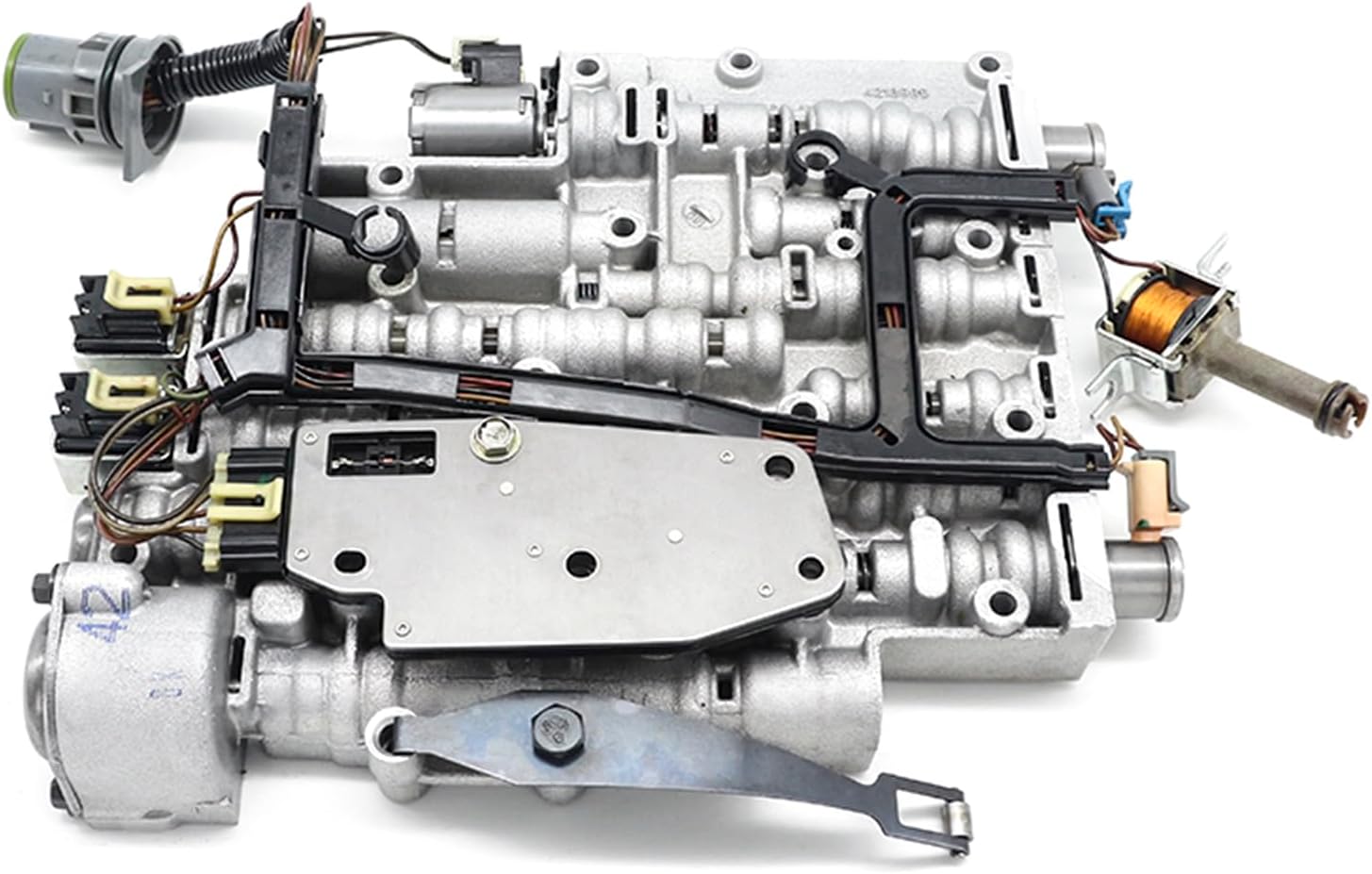
Start With the Van, Not the Valve Body
Every 4L60E Astro and Safari (1993-2005) has the same layout: a 4.3L Vortec up front, a column shifter, and the transmission tucked under the doghouse where it runs hot. Before you diagnose a shift complaint, check three things that have nothing to do with a failed part.
Tow/haul mode
Later vans have a tow/haul button on the end of the column shift lever. GM's 2003 Astro owner manual says tow/haul is meant to reduce the frequency of shifts when pulling a heavy trailer and to give the same shift feel loaded as unloaded. It also says that running in tow/haul without a heavy trailer will not damage anything but can bring reduced fuel economy and undesirable performance from the engine and transmission. If the TOW/HAUL light on the cluster is on, that late, firm shift may be the van doing what it was told to do. GM notes that the mode turns itself off every time the van is started, so a complaint that goes away after a restart is a clue.
Range selection
The same manual tells owners to use THIRD (3) when carrying a heavy load or on steep hills, and says DRIVE is fine for normal towing. A van that "never shifts to 4th" with the lever in 3 is working correctly.
Fluid
Low fluid shows up as erratic shifts and flares before it shows up as a hard slip. Check it hot at 180-200°F with the procedure in our Astro slipping guide. The Astro takes 5.0 quarts on a pan drop.
The Solenoid Table That Solves Most Astro Shift Complaints
The 4L60E shifts on two on/off solenoids: A (the 1-2 shift solenoid) and B (the 2-3 shift solenoid). Barry Bartlett, an ASE Master and L1 diagnostician, laid out the logic in Transmission Digest using this exact unit:
| Gear | Solenoid A (1-2) | Solenoid B (2-3) | Holding elements |
|---|---|---|---|
| 1st | On | On | Forward clutch, forward sprag, low roller clutch |
| 2nd | Off | On | Forward clutch, 2-4 band |
| 3rd | Off | Off | Forward clutch, 3-4 clutch |
| 4th | On | Off | 3-4 clutch, 2-4 band |
From that table Bartlett works out what each failure feels like from the driver's seat:
- No power to either solenoid: 3rd gear only in Drive, with no upshift or downshift. Manual 2nd still works because it is hydraulically shifted into 2nd without solenoids.
- Solenoid A never turns on: 2nd gear starts, a shift to 3rd, and no 4th. Second and third are the only forward gears.
- Solenoid B never turns on: 4th gear starts. Manual 2nd and 3rd still give you gears up to about 30 mph.
- Missing 2nd and 4th with everything else fine: not a solenoid at all. The 2-4 band is common to both gears. Bartlett notes the sun gear can break away from the sun shell on the 4L60E and take out 2nd, 4th and reverse.
That last one fools owners. Bartlett describes customers who say the transmission holds 1st a long time and only shifts when they lift. They think it went into 2nd, but it actually went into 3rd, and nobody noticed there was never a 4th. If your Astro feels like a three-speed with a lazy first shift, get a gear count from the scan tool before blaming a solenoid.
Stuck in 3rd: Find the Lost Power
An Astro that drives off in 3rd, will not downshift, and has a working manual 2nd is in the no-power state. Per Bartlett, a total loss of solenoid power normally sets several solenoid codes at once. Work it like an electrical fault:
- Pull codes and freeze frame first. Multiple shift solenoid circuit codes together point at a shared feed, not two dead solenoids. Single-solenoid codes have their own guides: P0751 and P0756.
- Check the fuse and the feed. Confirm power on both sides of the transmission fuse, then at the transmission connector. Bartlett notes that no power at the fuse can be an ignition switch problem, which he calls common on Chevrolet.
- Command the solenoids. With a bidirectional scan tool, command each solenoid and listen for the click.
- Check the connector at the case. On a van that has leaked fluid for years, the case connector and internal harness take a soaking. A pin that loses contact only when hot makes the van drop into 3rd on the highway and come back after it cools.
2nd Gear Starts or No 4th With Good Solenoids: The AFL Bore
If both solenoids click on command and the codes still say solenoid performance or ratio error, look at what feeds them. The actuator feed limit (AFL) valve regulates the oil that supplies the shift solenoids and the pressure control solenoid. Sonnax's page for its AFL valve kit (77754-09K) explains the wear: the OE valve has a large reaction area, side-loading wears the bore, and the pressure control solenoid oscillates the torque signal and AFL oil, which keeps the valve moving and speeds up the wear.
As the bore wears, less oil reaches the solenoids. Sonnax lists the results as wrong gear starts, 2nd gear starts, no 4th, solenoid performance codes, erratic line pressure, harsh shifts, and clutch and band failure. AFL wear copies the dead-solenoid symptoms with good solenoids installed, which is how an Astro gets two sets of new solenoids and still starts in 2nd. Vacuum-test the AFL bore. A leaking bore needs the repair valve and sleeve, which requires reaming, or a valve body that has already been corrected.
Harsh Shifts and Harsh Engagements
Check the pressure control command first
The 4L60E sets line pressure with a pressure control solenoid (also called EPC or PCS). The computer commands a current, and less current means more pressure. Wayne Colonna wrote up a 4L60-E case for Transmission Digest with harsh engagements and harsh shifts, no transmission codes, and scan data showing no amperage command to the EPC solenoid, so line pressure was at maximum. The cause was not in the transmission. The engine was running lean with lean codes stored, and the computer had stopped trusting its engine torque signal. His truck was a Silverado running ethanol fuel it was not built for, but the lesson applies to any 4L60E: when everything is harsh and there are no transmission codes, read the engine codes and the commanded PC solenoid current before you drop the pan. Our P0748 guide covers the solenoid circuit itself.
If the command looks normal and the shifts are still hard, put a gauge on the line pressure tap and compare idle and stall readings in each range to the factory spec. Our line pressure guide has the procedure.
Harsh 1-2 at light throttle: the accumulator valve
The 1-2 and 3-4 shifts are cushioned by accumulators, and the accumulator valve sets their backing pressure. Maura Stafford's Sonnax article on accumulator valve codes explains that this pressure rises with engine torque, so heavy throttle gives a quicker, firmer apply and light throttle gives a softer one. The letter stamped on the accumulator valve sleeve identifies the spool size and therefore the pressure curve. Early 4L60-E sleeves were coded C, and later ones YZ, CX and DX. A stronger-than-stock spring pushes the curve up and firms every shift.
So a van that bangs into 2nd at light throttle may have a worn sleeve, a sticking valve, a heavy spring someone added years ago, or the wrong sleeve code after a valve body swap. Read the code on the sleeve before you order a replacement or add a shift kit.
2-3 Flares and 3-2 Bind-Up
On the 2-3 shift, the 2-4 band has to release as the 3-4 clutch applies. If the band lets go early, the engine flares. If it hangs on, the shift binds. Sonnax's servo release check valve kit (77701-076) page names the cause as inadequate metering of 2nd servo release oil, with symptoms of poor 2-3 shift feel, 3-2 bind-up and reduced 3-4 clutch life. The kit has to be used with a working OE 3rd accumulator checkball assembly. Do not mix up the two balls, and do not cup-plug the 3rd accumulator: Sonnax notes that plugging it often leads to soft 2-3 shifts and 3-2 flares.
If the valve body checks out and the flare remains with no codes, test the computer. The slow-releasing B solenoid driver case is covered in our Astro slipping guide.
Scan Data Worth Watching on an Astro
The 4L60E has no input (turbine) speed sensor, so you prove the gear another way. With the converter clutch applied, engine RPM divided by output shaft RPM should match the gear ratio: 3.06, 1.63, 1.00 or 0.70. Log these on one road test:
- Commanded gear and the 1-2 and 2-3 shift solenoid states. Compare them to the table above at every shift.
- Throttle position in percent. Sweep the pedal slowly with the key on and the engine off. Any dropout or jump makes the computer shift erratically.
- Vehicle speed and output speed. A sensor that drops out mid-shift causes harsh downshifts and erratic upshift points.
- PC solenoid commanded and actual current. Watch both. A large gap between commanded and actual points at the circuit or the solenoid.
- Transmission fluid temperature. A sensor that reads cold delays converter clutch apply and changes shift timing.
The Fix Order
- Confirm tow/haul is off and the lever is really in D. Check the fluid hot.
- Pull engine and transmission codes. Fix engine faults that affect the torque signal first.
- Road test with the solenoid table and the data list above. Name the gear state, not just the feel.
- Electrical: fuse, feed, connector, and the solenoid command test.
- Hydraulic: vacuum-test the AFL bore, check the accumulator valve sleeve code and wear, check the 3rd accumulator checkball, and gauge line pressure.
- Replace solenoids as a set if one is weak, and correct the AFL bore at the same time so the new solenoids get full feed.
4L60E Master Solenoid Kit, 1993-2006
A and B shift solenoids plus the pressure control, TCC, 3-2 and PWM solenoids for the full Astro and Safari 4L60E run. For valve bodies and single solenoids, see the full 4L60E lineup here.
See the master solenoid kit →FAQ
Why won't my Astro van shift out of one gear?
If the van starts in 3rd and never shifts in Drive, the shift solenoids have probably lost power, because both solenoids off is the 3rd gear state on a 4L60E. Check the transmission fuse, power at the transmission connector and the stored codes, then command the solenoids with a scan tool and listen for them to click. Manual 2nd still works without solenoids, which confirms an electrical cause.
What causes harsh shifting in a 4L60E Astro?
The usual causes are line pressure that is too high and accumulator control that is too firm. Check the commanded pressure control solenoid current on a scan tool, because zero amperage command means maximum line pressure, and look for engine codes that corrupt the torque signal. Inside the valve body, a worn or wrong-code accumulator valve sleeve and AFL bore wear also cause harsh shifts.
Can a bad shift solenoid cause no 4th gear?
Yes. On a 4L60E the A (1-2) solenoid must turn on for 4th. If it does not, the van starts in 2nd, shifts to 3rd and never reaches 4th. A worn AFL valve bore produces the same no-4th and 2nd-gear-start symptoms with good solenoids, because it starves the solenoids of feed pressure.
How do I reset an Astro van transmission?
There is no reset that fixes a mechanical or hydraulic fault. Clearing codes or disconnecting the battery only erases stored data and can make diagnosis harder. Record the codes and freeze frame first, check the fluid hot, then work through the solenoid and pressure checks in order.
Keep the numbers at the bench. Our free transmission fluid spec chart lists the correct ATF type for the 4L60E and dozens of other units, so you never top off with the wrong fluid.
Sources
- General Motors — 2003 Chevrolet Astro Owner Manual. Backs: tow/haul button location and purpose (fewer shifts, same shift feel loaded), automatic shut-off at every start, "undesirable performance" when used without a heavy trailer, DRIVE for normal towing and THIRD for heavy loads and steep hills. GM: 2003 Astro owner manual (PDF)
- Transmission Digest — Diagnosing Shifting Issues (Barry Bartlett, 2016). Backs: 4L60E solenoid states by gear, 3rd gear only with no solenoid power, hydraulic manual 2nd, the A-solenoid and B-solenoid failure patterns, missing 2nd and 4th from the 2-4 band and sun shell, the "shifts when I lift" 1-3 complaint, fuse and ignition switch checks, and scan tool solenoid command testing. transmissiondigest.com/diagnosing-shifting-issues
- Transmission Digest — Avoiding 4L60-E Harsh Shifts and Engagements (Wayne Colonna, 2022). Backs: harsh engagements and shifts with no transmission codes, no amperage command to the EPC solenoid giving maximum line pressure, and the lean engine and torque signal cause. transmissiondigest.com/avoiding-4l60e-harsh-shifts-engagement
- Sonnax — Actuator Feed Limit Valve Kit 77754-09K. Backs: AFL bore wear from side-loading and EPC oscillation, low pressure at the shift and EPC solenoids, and the symptom list of wrong gear starts, 2nd gear starts, no 4th, solenoid performance codes, erratic line pressure and harsh shifts. sonnax.com/parts/2459
- Sonnax — 4L60, 4L60-E Accumulator Valve Codes and Shift Feel (Maura Stafford, 2021). Backs: accumulator pressure rising with engine torque, sleeve letter codes setting the pressure curve, the C, YZ, CX and DX 4L60-E codes, and stronger springs firming the shift. sonnax.com/tech_resources/1061
- Sonnax — Servo Release Check Valve Kit 77701-076. Backs: inadequate metering of 2nd servo release oil causing poor 2-3 shift feel, 3-2 bind-up and reduced 3-4 clutch life, the requirement for a working OE 3rd accumulator checkball, and soft 2-3 shifts and 3-2 flares from cup-plugging it. sonnax.com/parts/2432