If you own a 1997 through 2004 F-150 with the 4.2L V6, 4.6L or 5.4L V8 and an automatic, you almost certainly have a 4R70W. These trucks are now 20 to 29 years old, and a lot of them have never had the fluid changed, or had it done once at a quick lube with whatever was on the shelf. This guide is the F-150 version of the question I get most at the counter: what fluid does it take, how much do I buy, how often should it be done, and what does it cost.
The short version: MERCON V, Ford lists 13.2 L (13.9 quarts) as the approximate dry-fill capacity, a pan drop takes back far less than that, and if the truck tows or plows, Ford's own schedule says change it every 30,000 miles. The details below are pulled from Ford's 2003 F-150 owner guide and 2003 scheduled maintenance guide, the Motorcraft MERCON V data sheet, and ATRA's GEARS Magazine. Every source is linked at the bottom.


F-150 4R70W fluid spec at a glance
| Item | Spec | Where it comes from |
|---|---|---|
| Fluid | Motorcraft MERCON V ATF, part XT-5-QM (quart) | Ford 2003 F-150 owner guide, lubricant specifications |
| Approximate dry-fill capacity | 13.2 L (13.9 qt), includes the cooling system | Ford 2003 F-150 owner guide, capacities table |
| Typical pan-and-filter refill | About 5 to 6 qt with the stock pan | Shop experience, not a Ford number |
| Hot check temperature | 66-77°C (150-170°F) | Ford 2003 F-150 owner guide |
| Top-off increment | 250 ml (1/2 pint) at a time | Ford 2003 F-150 owner guide |
| Change interval, towing / severe use | Every 30,000 miles | Ford 2003 scheduled maintenance guide |
| Change interval, normal use | Not scheduled; inspect level only | Ford 2003 scheduled maintenance guide |
The fluid: MERCON V, and check the dipstick
The 2003 F-150 owner guide lists two different automatics in the same truck line and two different fluids. The 4R100 (used behind the supercharged Lightning) calls for Motorcraft MERCON ATF, part XT-2-QDX. The 4R70W calls for Motorcraft MERCON V, part XT-5-QM. That split is the main reason people get confused when they look up "F-150 transmission fluid" and find two answers.
Ford's footnote says the fluid requirement is printed on the dipstick or dipstick handle. On a truck this old, read it, because a used-unit swap can put a different transmission behind the engine than the build sheet says. The guide's era warning not to mix MERCON and MERCON V is outdated now: licensed MERCON is long gone and MERCON V is the service fluid for both, which our 4R70W fluid type and capacity guide walks through with Ford's bulletin.
What makes MERCON V different from a generic bottle is a measured spec, not a marketing claim. Motorcraft's product data sheet for its MERCON V lists license number M5091101, a kinematic viscosity of 7.5 cSt at 100°C and 33.2 cSt at 40°C, a viscosity index of 205, and a pour point below -48°C (-54°F). If you buy an aftermarket fluid, look for a fluid that states it is approved or licensed for MERCON V, not one that says "suitable for use in" a long list of specs with no license number anywhere.
The owner guide also says not to add supplemental fluid additives, treatments or cleaning agents. A slipping 4R70W needs a diagnosis, not a bottle.
How much fluid to buy
The 13.9 quart figure is the number most people order by, and it is the wrong number for a service. Ford's footnote calls it an approximate dry-fill capacity that includes the transmission fluid cooling system, and says actual refill capacities vary with the cooler size, the cooling lines and any auxiliary cooler. Ford's instruction is that the amount and the level are set by the dipstick's normal operating range, not by the chart.
The 4R70W has no factory drain plug. Dropping the pan only gets out what is in the pan. The torque converter, cooler and lines keep their fluid. Here is what I tell F-150 owners to have on hand:
- Pan drop and filter, stock pan: 6 quarts covers it. It usually takes 5 to 6 back. That is my bay number, not a Ford spec.
- Two pan drops a few hundred miles apart (the gentle way to freshen neglected fluid): 12 quarts.
- Pan drop plus a cooler-line exchange: plan on 16 to 20 quarts. You push fluid through until what comes out looks like what goes in, and that always takes more than the capacity number.
- Deep aftermarket pan or a big auxiliary cooler: add 1 to 3 quarts to any of the above.
- After a rebuild or a reman install, dry: start with the full 14 and set the final level hot on the stick.
A 12-quart case of MERCON V is the sensible buy for an F-150 owner. It covers a pan service with fluid left over for top-offs, or two pan drops back to back.
How often: what Ford's schedule actually says
This is where a lot of F-150s got neglected. Ford's 2003 scheduled maintenance guide, in the normal schedule at 30,000-mile intervals, says to change the automatic transmission fluid on vehicles equipped with the AX4S, 4F50N, 4R100 and 4F27E, and to inspect the fluid level on all other vehicles. The 4R70W falls in the "all other" group. Under the normal schedule, Ford never told owners to change it.
The special operating conditions schedule is a different story. Ford lists towing a trailer or using a camper or car-top carrier, extensive idling or low-speed driving as in delivery, taxi, patrol or livery use, operating on dusty or unpaved roads, and off-road operation. Each of those conditions carries the same line: change automatic transmission fluid every 30,000 miles. The owner guide's towing section backs it up with "If you tow a trailer for long distances, your vehicle will require more frequent service intervals."
Pat Burrow made the point in GEARS Magazine that most owners' driving fits the manual's severe service definition, and F-150s tow, haul and idle on job sites more than most. Treat any F-150 4R70W as a special-conditions truck and service the fluid every 30,000 miles. If it tows heavy all summer, every 15,000 to 20,000 is cheap insurance on a 25-year-old unit.
Checking the level the Ford way
Most overfill and underfill problems I see come from people checking cold on a slope. Ford's procedure from the 2003 F-150 owner guide:
- Drive about 30 km (20 miles), or until the fluid reaches normal operating temperature of 66-77°C (150-170°F). If the truck has been towing, running hot in traffic or at sustained high speed, shut it off for about 30 minutes to let the fluid cool before checking.
- Park on a level surface and set the parking brake.
- With your foot on the brake, start the engine and move the shifter through every range, giving each gear time to engage.
- Latch it in Park and leave the engine running.
- Pull the dipstick, wipe it with a clean lint-free rag, reinsert it fully seated, and pull it again to read.
Ford allows a cold check above 10°C (50°F), but fluid added then can become an overfill once it warms up. Add only in 250 ml (half-pint) increments through the filler tube. If the level is at the bottom of the stick with ambient above 50°F, Ford says do not drive the truck. Ford also warns that an overfill can cause shift and engagement concerns, and that a high reading can come from overheating. If the stick reads high and the fluid smells cooked, find out why before you pull fluid out.
Read the old fluid before you change it
On a high-mileage truck, the fluid you drain is a diagnostic sample. Burrow's GEARS article describes how a careful shop handles a high-mileage service: pull a sample and compare its smell and color against new fluid, check the pan and magnet for debris, ask about service history, and make sure reverse works on a short test drive before the truck even goes in the bay. If reverse is soft or missing before the service, the fluid change did not cause what happens next, and the owner needs to know that up front.
Burrow also explains why some old units fail after a fluid change: fresh fluid's detergency can loosen deposits that end up in solenoids and valves, and a full flush makes that more likely. His approach for neglected units is a partial service (pan, filter, refill, converter left alone), which removes roughly half the old fluid with much less disturbance.
The F-150 runs its transmission cooler through a tank in the radiator, so coolant contamination is a real possibility on a truck with an old radiator. Mike Brown's GEARS piece on ATF contamination makes the key point: coolant or water can damage clutches without giving the fluid the milky look people expect. He uses two test strips, one for antifreeze and one for water. Both react: a coolant leak. Only the water strip: look for water getting in from outside, such as through the vent. Brown also notes moisture absorbed into the clutch material cannot be removed, so contaminated clutches have to be replaced. Fresh fluid on top of glycol-soaked frictions is money wasted.
Doing the service on an F-150
The pan and filter job itself is covered step by step in our 4R70W filter and pan service guide, and the flush question is in 4R70W flush vs drain and fill. The F-150 specifics I add:
- Use a one-piece rubber-bonded pan gasket and torque the pan bolts low and even. Over-torqued pan bolts are the classic F-150 pan leak.
- Look at the magnet. Fine gray paste is normal wear. Brass or bronze flakes point to bushings or thrust washers. Steel chunks mean a hard-parts failure is already underway, and a fluid change will not save it.
- Cooler-line exchange: with the pan service done and the level correct, disconnect the cooler return line, run it into a marked container, and idle in Park while a helper adds fresh fluid down the filler tube at the same rate it comes out. Stop before the pump draws air. On a truck with a big aftermarket cooler you will go through more fluid than you expect.
- Towing trucks: the owner guide lists an auxiliary automatic transmission fluid cooler as part of its snowplow prep equipment, and says to use a lower gear when towing to cut excessive shifting and help transmission cooling. An F-150 that tows without an auxiliary cooler is cooking its fluid.
What a fluid change will not fix
A fluid service is maintenance. If the truck already slips, shifts soft under load or flares on the 2-3, new fluid may help for a few weeks, then the symptom comes back. A common cause on these is low line pressure from a worn pressure regulator valve. Sonnax documents PR valve scoring on the EPC end in the 4R70W and its relatives, with reduced line pressure and low line rise as the symptoms. The bore usually wears along with the valve, so the fix is reaming and an oversize valve, confirmed with a vacuum test, not a fluid change. If your F-150 has those symptoms, start with our 4R70W F-150 slipping guide and the F-150 common problems guide.
What it costs
Parts are the predictable part of the bill. Using the prices on our own store as a reference:
| Job | Parts | Parts cost (approx.) |
|---|---|---|
| Pan drop and filter, DIY | FT105-style filter and gasket kit, 6 qt MERCON V | $27 filter kit plus about half a $174 case of MERCON V |
| Two pan drops (neglected fluid) | 2 filter kits, 12 qt MERCON V | About $228 |
| Pan drop plus cooler-line exchange | Filter kit, 16-20 qt MERCON V | About $260 to $320 |
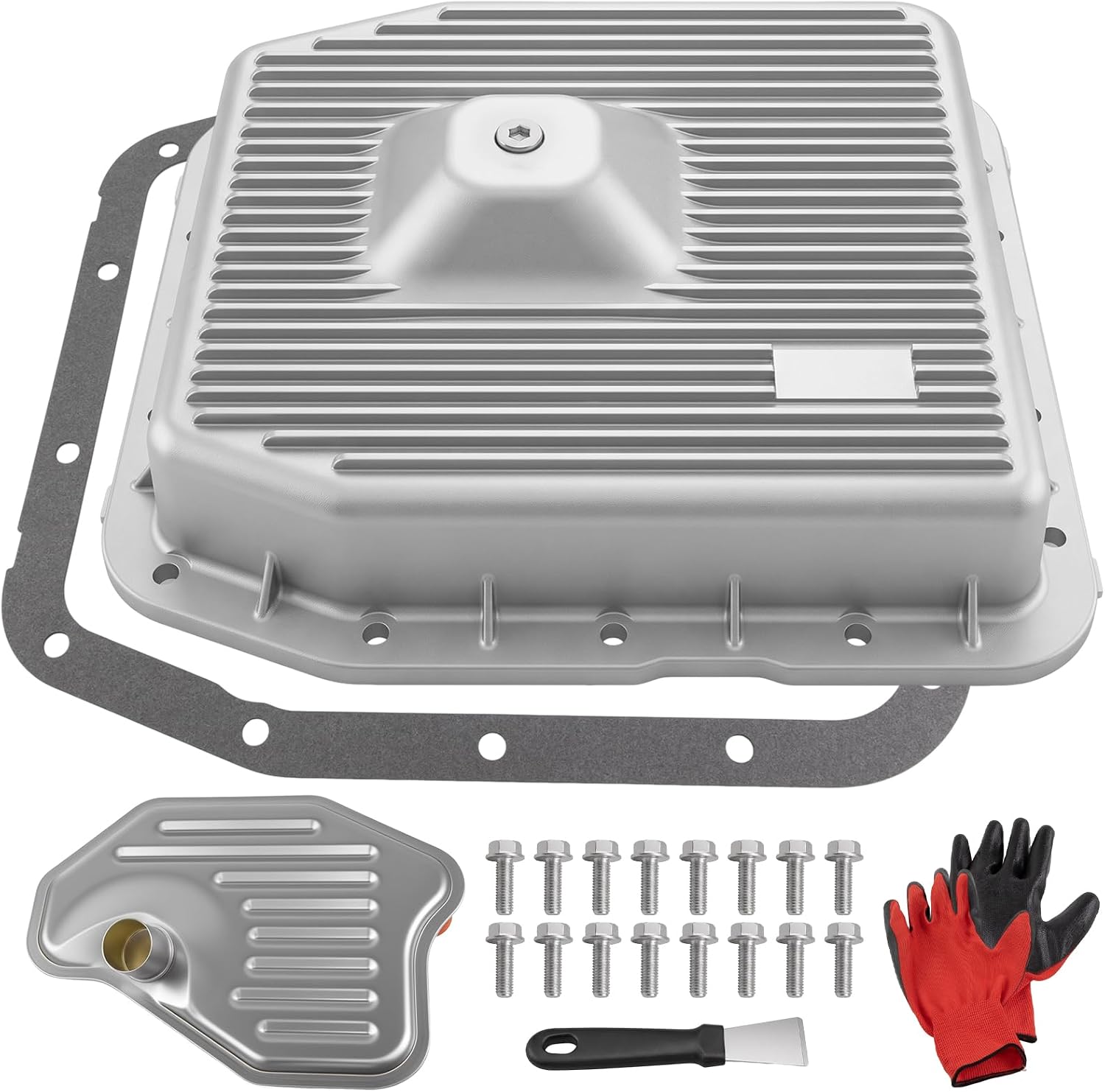
| Convert to a drain-plug pan | Aluminum pan kit with filter and magnetic plug, fluid | About $222 plus fluid, once |
Shop labor varies too much by region to quote honestly. Compare any of these numbers to a 4R70W rebuild and the 30,000-mile interval looks cheap.
4R70W filter and pan gasket kit, 1996-2011
The FT105-pattern filter and gasket kit for the stock 14-bolt F-150 pan. Order it with the fluid so the service is done in one trip under the truck. Sold by our sister store, CoreTransmissionParts.
Shop the part for this fix →Need a deep pan, cooler lines or a rebuild kit? The 4R70W parts collection has the full range.
Need parts for this job?
MERCON V by the case, FT105 filter kits, aluminum drain-plug pans and replacement coolers for the 1997-2004 F-150 are all on our 4R70W parts page, with checkout on site.
FAQ
What transmission fluid does a 4R70W F-150 use?
MERCON V. Ford's 2003 F-150 owner guide lists Motorcraft MERCON V, part XT-5-QM, for the 4R70W, while the 4R100 in the same truck line called for MERCON. The requirement is also printed on the dipstick or dipstick handle, so check it on any truck that may have had a transmission swapped in.
How many quarts does a 4R70W F-150 take for a fluid change?
Ford lists 13.2 L (13.9 quarts) as the approximate dry-fill capacity including the cooler, but that is not what a service takes. A pan drop and filter on the stock pan usually takes back 5 to 6 quarts, and a pan drop plus cooler-line exchange takes about 16 to 20. Always set the final level hot on the dipstick.
How often should a 4R70W F-150 have the fluid changed?
Ford's 2003 normal schedule only calls for inspecting the 4R70W fluid level. Under special operating conditions, which include towing, extended idling, dusty roads and off-road use, Ford says change it every 30,000 miles. Most F-150s fit that description, so 30,000 miles is the interval to use.
Should I flush a high-mileage 4R70W?
On a neglected unit, a partial service is safer. GEARS Magazine notes that fresh fluid can loosen deposits that end up in valves and solenoids after a full flush. Drop and clean the pan, change the filter and refill, then repeat a few hundred miles later if the fluid was badly oxidized.
Related guides
- 4R70W Fluid Type and Capacity
- 4R70W Filter and Pan Service Guide
- 4R70W Flush vs Drain and Fill
- 4R70W F150 Common Problems and Fixes
- 4R70W Overheating Prevention
Sources
- Ford Motor Company — 2003 F-150 Owner Guide, Maintenance and Specifications chapter (archived copy). Backs the MERCON V requirement and part XT-5-QM for the 4R70W, MERCON / XT-2-QDX for the 4R100, the 13.2 L (13.9 qt) dry-fill capacity and its footnote, the dipstick check procedure and 66-77°C range, the 250 ml top-off increment, the no-additives warning, and the towing service note. Ford 2003 F-150 owner guide (PDF)
- Ford Motor Company — 2003 Scheduled Maintenance Guide (archived copy). Backs the normal schedule (change ATF only on AX4S, 4F50N, 4R100 and 4F27E; inspect level on all others) and the special operating conditions list with its 30,000-mile ATF change interval. Ford 2003 maintenance guide (PDF)
- Ford Customer Service Division (Motorcraft) — MERCON V Automatic Transmission Fluid Product Data Sheet. Backs license number M5091101, 7.5 cSt at 100°C, 33.2 cSt at 40°C, viscosity index 205 and pour point below -48°C. Motorcraft MERCON V data sheet (PDF)
- GEARS Magazine (ATRA) — Pat Burrow, "Is It Safe to Change Transmission Fluid in High-Mileage Vehicles?" Backs the pre-service fluid sample and pan inspection, checking reverse before service, the risk of loosened deposits after a full flush, the partial-service approach, and most owners meeting the severe service definition. gearsmagazine.com
- GEARS Magazine (ATRA) — Mike Brown, "Identifying ATF Contamination." Backs coolant and water contamination without a milky appearance, the two-strip antifreeze and water test, and clutches that cannot be saved once they absorb moisture. gearsmagazine.com
- Sonnax — Brian Wing, "Watch Out for 4R70W Pressure Regulator Valve & Casting Wear." Backs the EPC-end PR valve scoring, reduced line pressure and low line rise, bore wear, the vacuum test and the oversize valve repair. sonnax.com