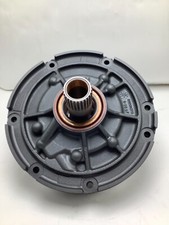
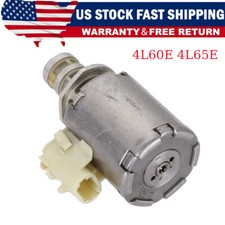
The 4L60E sits behind more GM rear-drive vehicles than almost any automatic ever built: Silverado and Sierra 1500 pickups, Tahoe, Yukon and Suburban SUVs, S-10 and Sonoma trucks, Blazers, Camaros and Corvettes. When one of them starts taking its time to engage, slips through the gears, or develops a hum that rises with engine speed, the front pump is one of the first assemblies to check. This is a remanufactured GM 4L60E pump, supplied complete and backed by a 1-year warranty. Because GM revised the pump many times between 1993 and 2013, the most important step on this page is matching it to your transmission, covered below.
What the pump does in a 4L60E
Every psi the 4L60E uses comes from this assembly. GM's service information describes a 13-vane, variable-displacement pump: the converter hub spins a rotor inside a slide, and the slide pivots to change how much oil each revolution moves. The pressure regulator valve and boost valve in the pump cover position that slide to hold the line pressure the PCM commands through the pressure control solenoid. The cover also contains the converter clutch valving and the stator shaft, so the pump decides how well the converter charges and locks as well as how firmly the clutches apply.
Symptoms of a failing 4L60E pump
- Drive and reverse are slow to engage, especially hot
- Slipping that is not limited to one gear
- A whine tied to engine RPM that is present in park
- Burnt 3-4 clutches and early clutch failure from chronically low pressure
- Torque converter clutch slip or shudder, often with P0741 or P1870 stored
- Harsh or soft shifts that mimic a pressure control solenoid problem and code P0748
How to confirm it is the pump
Before buying any hard part, measure line pressure with a gauge in drive and reverse at idle and under load. Low pressure in every range points to internal leakage in the rotor, vanes or slide; Sonnax notes that a worn slide pivot pin can push pressure either too low or too high. Pressure that drops only in reverse or at heavy throttle points to the regulator and boost valve. If pressure is normal, the problem is elsewhere, and our 4L60E common problems guide is the next stop. For a closer look at the four wear points inside the pump, read 4L60E pump rotor and bushing wear.
Fitment: matching the right generation
This listing is not tied to a specific year, so treat your old pump as the template. Wayne Colonna's 4L60-E history in PTEN lays out the main dividing lines: a PWM converter clutch solenoid joined the system in 1995, the slip-controlled EC3 converter strategy spread to all models in 1998, and an input speed sensor was phased into the pump during 2005 and fully implemented for model year 2006, with matching changes to the stator shaft and input shaft. In 2009 the 3-2 downshift solenoid was eliminated. Pumps from different sides of these changes can look alike but are not interchangeable. Compare the cover casting, stator shaft, converter hub bore and any sensor boss or plug, and send us your year and VIN if there is any doubt. If you already know your year, the dated options such as the 1996-2002 4L60E pump and the 2007 4L60E pump remove the guesswork. Everything else for this unit is in the 4L60E parts collection.
Install notes
- Check the converter hub; scoring or bluing on the hub will wear out the new bushing and seal.
- Install new pump-to-case seals and a front seal, and center the pump in the case with a front pump alignment band before tightening the bolts gradually.
- Check input end play once the pump is torqued.
- If you are servicing pump internals on the bench instead, a pump slide spring installer makes reassembly safer.
- Use Dexron VI, pre-fill the converter and fill the case before the first start so the pump primes.
- After a debris failure, flush the cooler and lines so the new pump does not ingest the old material.