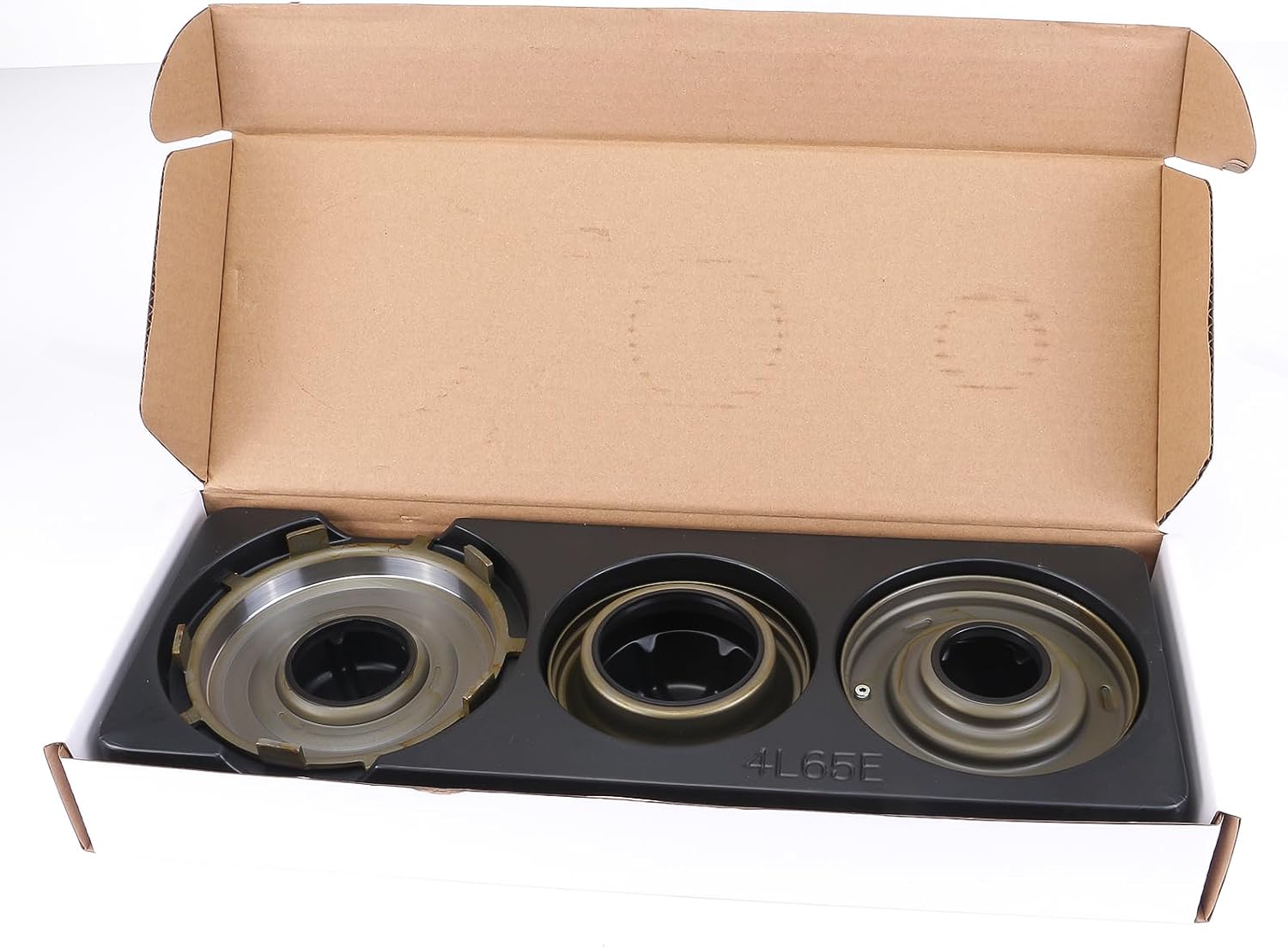
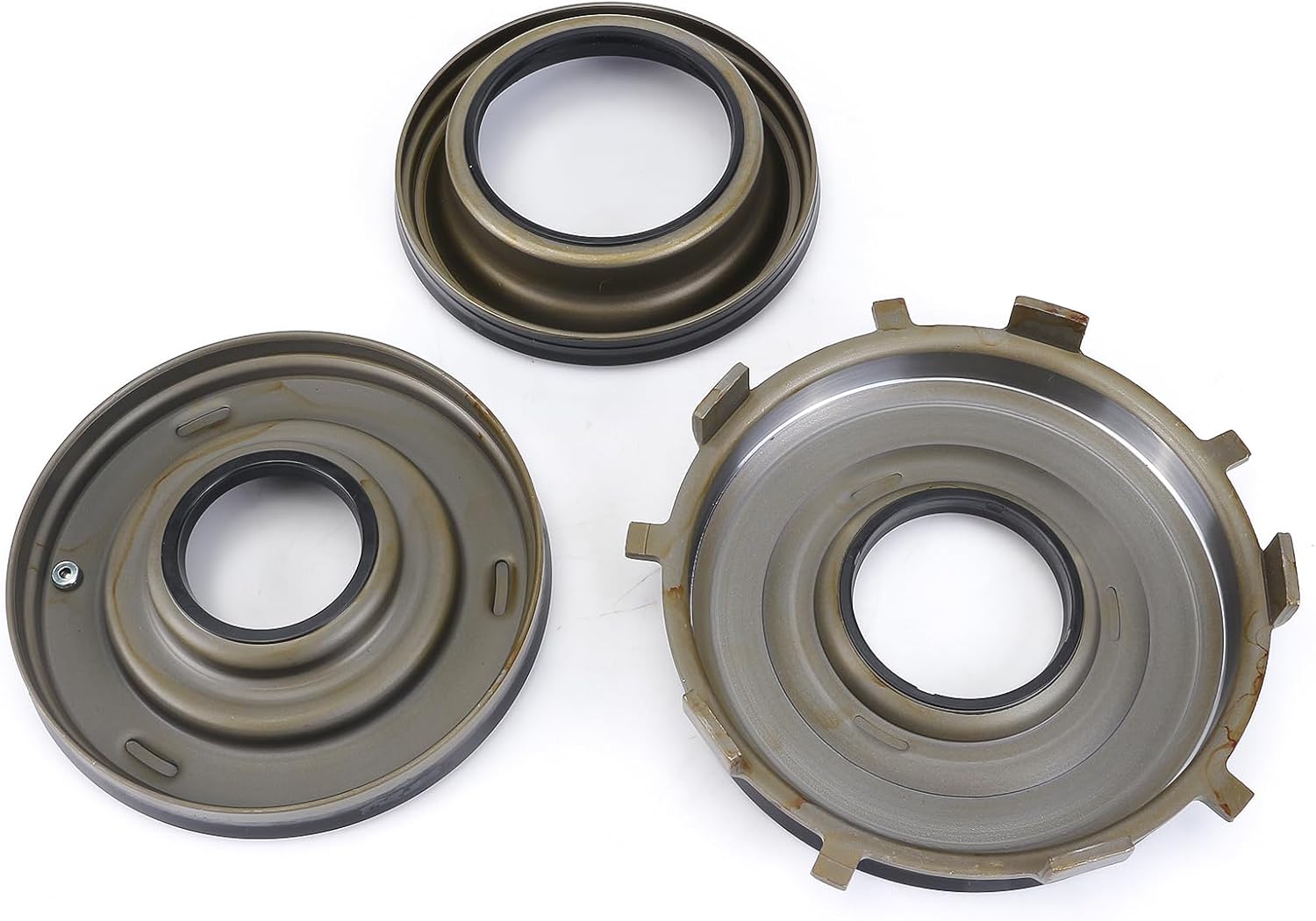
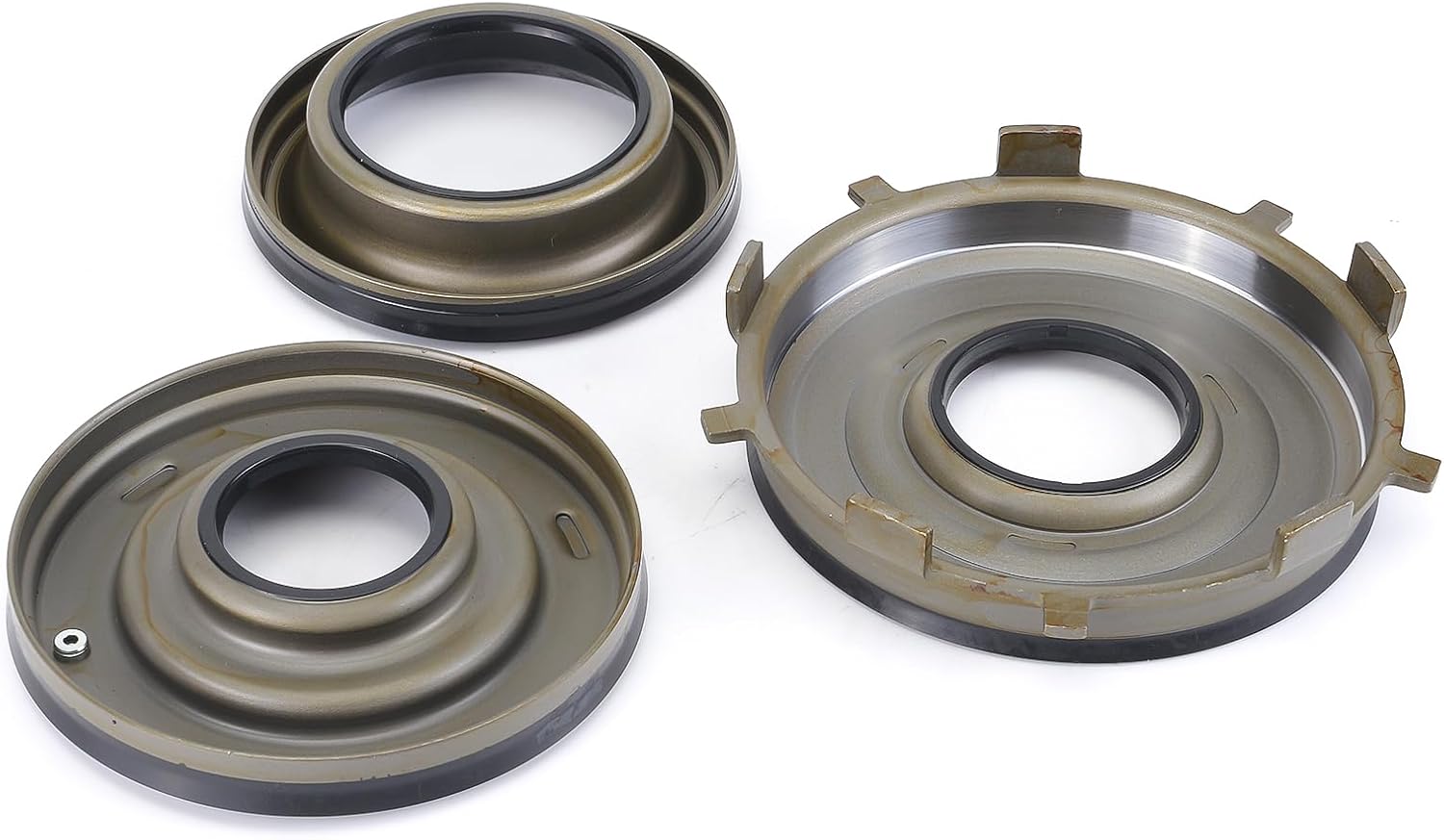
If your Silverado, Sierra, Tahoe, Yukon, S10 or Camaro 4L60E flares into third, slips going into overdrive, or came apart with a black 3-4 clutch pack, the pistons in the input drum deserve as much attention as the frictions. This set gives you all three bonded pistons that live in the 1994-up input housing: the 3-4 clutch piston, the forward clutch piston and the overrun clutch piston. The rubber is vulcanized onto each piston, so there are no loose lip seals to roll, nick or install upside down.
What the input drum pistons do in a 4L60E
The 4L60E input housing stacks three hydraulic clutches in one drum. Forward clutch oil drives the truck in every forward gear, the overrun clutch is applied in manual ranges to give engine braking, and the 3-4 clutch is applied for third and fourth. Each piston is pushed by its own fluid circuit against a return spring, and the only thing holding that pressure in is the seal lip on the inner and outer diameter. Once those lips harden or take a set from heat, apply oil bleeds past them. The pack still engages, but with less clamping force, so it slips, heats and glazes. The 3-4 circuit is the first to show it because that pack carries the full engine torque in the two highest gears. Sonnax lists leaks in the third-gear oil circuit as one of the main roots of burned 3-4 clutches, and a leaking piston is part of that circuit.
Symptoms that point at tired pistons
- Engine flare on the 2-3 or 3-4 shift, worst when the fluid is hot
- A rebuilt unit that burns the 3-4 pack again within a few thousand miles
- Delayed or soft engagement when you pull the lever into Drive (forward clutch)
- No engine braking in manual 3, 2 or 1 (overrun clutch, see our overrun clutch guide)
- Slip codes such as P0894 set alongside the burned 3-4 pack, rather than solenoid electrical codes
How to confirm before you buy
A piston leak cannot be seen from under the truck, so confirm it on the bench. With the drum assembled, apply regulated shop air to each feed hole one at a time. A good circuit gives a firm clunk as the piston strokes and then holds; a hiss past the piston or a slow, mushy apply means the lip is not sealing. Our bench air check walkthrough shows the feed holes and what a pass sounds like. Also check the input housing checkball while you are there; Sonnax specifies it should hold 25 in-Hg of vacuum, and a ball that leaks will dump 3-4 oil even with brand-new pistons. If the shift problem is electrical rather than hydraulic, start with the 4L60E common problems guide instead.
Fitment
These are the 1994-up pistons for the GM 4L60E, 4L65E and 4L70E input housing, the unit found in 1994-2013 Chevrolet and GMC full-size pickups and SUVs, S10 and Sonoma, Blazer and Jimmy, Astro and Safari, Camaro, Firebird and Corvette. The one trap is older hardware: if you are rebuilding a 1982-1993 700R4 or early 4L60 drum, you must also install the updated return spring assembly, GM 24206085, or the pistons will not work correctly. If your drum was swapped or you are unsure of its age, compare your old pistons to the photos or send us your year and VIN. More parts for this unit are on the 4L60E parts page.
Install notes
- Compress the return spring assembly with a press or a clutch spring compressor, remove the snap ring and lift out the spring and the old pistons.
- Clean the bores and check them for scoring with a fingernail; a scored drum will cut a new lip, so replace the drum if needed.
- Coat the bonded lips with assembly gel or clean ATF and start each piston square. A lip tool or a thin feeler run around the edge keeps the lip from folding back.
- Reinstall the spring and snap ring, then air check all three circuits before the drum goes in the case.
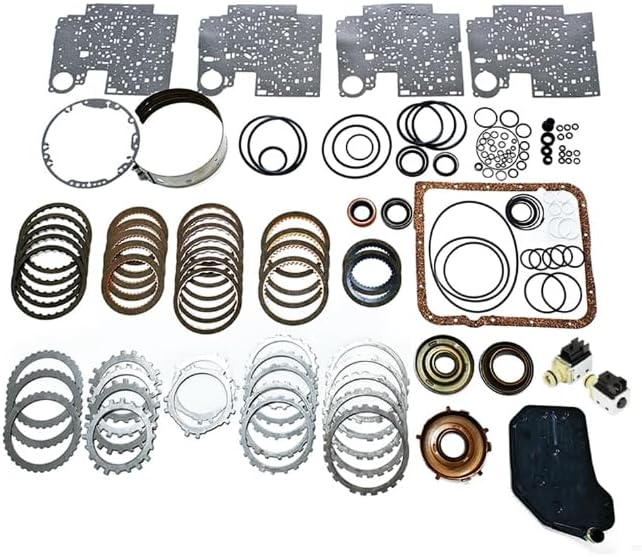
- Pistons are usually fitted with new frictions; the 1993-2003 master rebuild kit covers the soft parts, and a 3-4 friction 6-pack handles a pack that only needs clutches.
- Refill with Dexron VI ATF and check the level hot with the engine running.