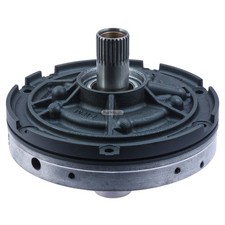
A 1997-2003 GM with the 4L60E that hesitates before it drops into Drive or Reverse, slips in every gear once it warms up, or whines in step with the engine is usually telling you the front pump can no longer hold line pressure. This listing is a complete remanufactured pump assembly for that era, with the cover, body and stator shaft already together as shown in the photo, backed by a 1-year warranty. It covers the years when these transmissions were going into GMT400 and GMT800 Silverado and Sierra 1500 pickups, Tahoe, Yukon and Suburban SUVs, S10, Sonoma and Blazer, Astro and Safari vans, and the Camaro and Corvette.
What the pump does in a 4L60E
The torque converter hub drives the pump rotor directly, so the pump turns whenever the engine runs. GM's own service information describes it as a 13-vane variable-displacement pump: the vanes ride inside a slide that pivots on a pin, and the pressure regulator swings that slide to trim output to what the transmission needs. Everything downstream depends on it. Clutch apply oil, converter charge and lube flow all start here, and the computer can only adapt line pressure within a narrow window above and below normal. Once a worn pump falls outside that window, no amount of electronic correction keeps the clutches clamped.
Two wear points matter most on high-mileage units from these years. Sonnax notes that a worn slide pivot pin lets pressure leak past and can cause either low or high line pressure, and the pressure regulator bore in the pump cover wears from constant valve movement. Both are inside the assembly you are replacing.
Symptoms of a failing 4L60E pump
- A one- to three-second delay engaging Drive or Reverse, worse when the fluid is hot
- Slipping or soft shifts across all gears rather than one shift point
- Whine that rises and falls with RPM, even in Park
- Burnt 3-4 clutches, the most common 4L60E failure, which low pressure accelerates
- Converter clutch slip or shudder, often logged as P0741, because converter apply oil passes through the pump and stator shaft
- Harsh or erratic shifts that a new pressure control solenoid did not fix
How to confirm it before you buy
Install a mechanical gauge on the line pressure tap and record readings at idle and stall in Drive and Reverse. Low pressure everywhere points at the pump. Pressure that is fine at idle but falls away under load points more toward the regulator and boost valve, which live in the pump cover, so this assembly still addresses it. Transmission Digest makes the point that the commanded pressure reading on a scan tool is not proof of real pressure; trust the gauge. If you find P0748 or a solenoid code instead, rule the electrical side out with our shift solenoid testing guide. Our 4L60E pump rotor and bushing wear guide covers the teardown checks once the pump is out.
Fitment
This pump is listed for 1997-2003 4L60E transmissions. That range straddles several running changes, including what builders describe as the move from a 298 mm to a 300 mm converter, which reached the LS-engine cars before the trucks, plus the 2003 change in pressure control solenoid. Before you order, compare your old pump with the photo: stator shaft, cover casting and the converter hub bore must match your converter and input shaft. If you are not sure which revision you have, send us your year and VIN. Older units can use the 1996-2002 4L60E pump, later trucks the 2004-2006 pump, and the full range is in our 4L60E parts collection.
Install notes
- Install a new front seal, pump-to-case O-ring and bolt washers, and inspect the converter hub; a grooved hub will chew through a new bushing and seal.
- Center the pump with an alignment band such as the SST-1097 pump alignment band while you torque the bolts in a cross pattern, then check that the input shaft still turns freely.
- Set input end play before final assembly; the SST-1055 pump puller and end play tool does both jobs.
- Prime the pump with ATF before the first start, fill with Dexron VI, and check the level hot in Park.
- If the old pump starved the unit, the 3-4 pack is probably cooked too, so plan on fresh frictions like the Raybestos RCP96-087 clutch pack.